


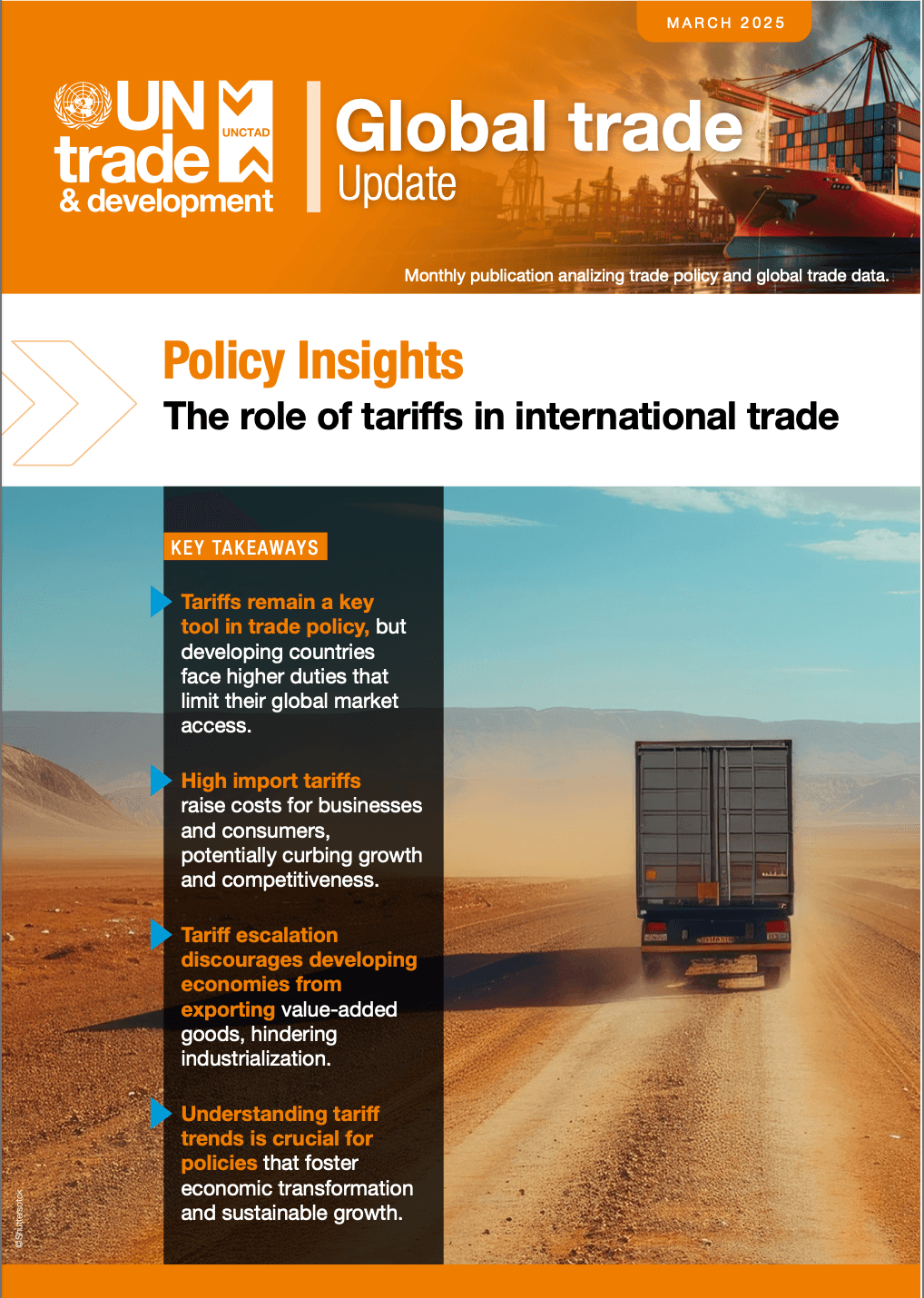

The Global Trade Update report from March 2025 published by UN Trade and Development examines the role of tariffs in international trade, highlighting their impact on developing countries. While global trends show a general decline in tariff rates due to trade liberalization and various trade agreements, developing nations still encounter higher tariffs that affect their trade competitiveness and economic development.
For these countries, tariffs serve multiple purposes: they provide essential government revenue, protect emerging industries by creating favorable conditions against established global competitors, and influence market access through complex trade agreements. However, high import duties can increase costs for businesses and consumers, potentially hindering economic growth. Additionally, the practice of tariff escalation—imposing higher tariffs on processed goods than on raw materials—discourages the export of value-added products, thereby impeding industrialization efforts.
The report also notes that agricultural products face some of the highest tariffs in international trade. While regional trade agreements and multilateral negotiations have reduced certain barriers, agriculture remains highly protected in many countries. Agricultural exports from developing countries face average import duties of nearly 20% under most-favored-nation treatment. Although preferential access schemes exist, they are often fragmented, leading to inconsistent market access. Notably, African, South Asian, and East Asian countries apply relatively high agricultural tariffs, whereas Latin American countries tend to have lower rates. Developed countries, despite having low average tariffs, often impose significant tariff peaks—sometimes exceeding 100%—on sensitive agricultural products like dairy, meat, and sugar.
The report underscores the importance of understanding tariff trends and their implications for market access, competitiveness, and economic transformation, particularly for developing nations striving for sustainable growth.