


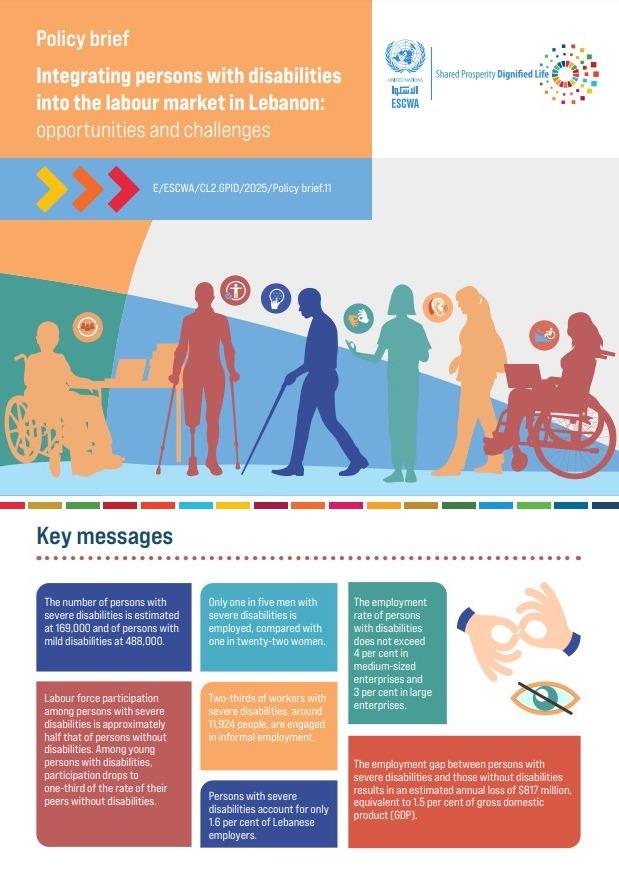

The present policy brief, published by UNESCWA, examines the reality of economic participation for persons with disabilities in Lebanon, focusing on the main challenges hindering their full inclusion in the labour market and in entrepreneurship.
The policy brief is based on a recent study conducted by the Economic and Social Commission for Western Asia (ESCWA), which included a survey of the perceptions of persons with disabilities and private sector companies. The aim was to identify obstacles from the perspective of each group and to pinpoint opportunities for enhancing economic inclusion. The brief offers practical recommendations to support the economic and social empowerment of persons with disabilities and promote their equitable participation in economic life.
Key messages:
The number of persons with severe disabilities is estimated at 169,000 and of persons with mild disabilities at 488,000.
Only one in five men with severe disabilities is employed, compared with one in twenty-two women.
The employment rate of persons with disabilities does not exceed 4 per cent in medium-sized enterprises and 3 per cent in large enterprises.
The employment gap between persons with severe disabilities and those without disabilities results in an estimated annual loss of $817 million, equivalent to 1.5 per cent of gross domestic product (GDP).
Labour force participation among persons with severe disabilities is approximately half that of persons without disabilities. Among young persons with disabilities, participation drops to one-third of the rate of their peers without disabilities.
Two-thirds of workers with severe disabilities, around 11,924 people, are engaged in informal employment.
Persons with severe disabilities account for only 1.6 per cent of Lebanese employers.