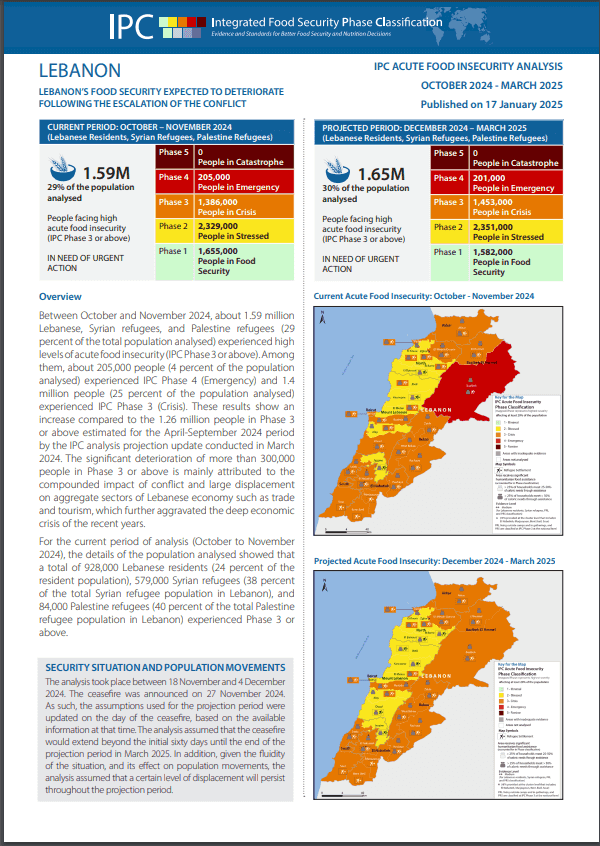





The acute food insecurity situation in Lebanon has further eased compared to the first half of 2025, but there are still a significant number of people facing high levels of acute food insecurity. Between November 2025 and March 2026, around 874,000 Lebanese residents, Syrian refugees, Palestine refugees and post-December 2024 arrivals from Syria continue experiencing IPC Phase 3 or above (Crisis or worse). This includes 22,000 people classified in IPC Phase 4 (Emergency) and 851,000 people in IPC Phase 3 (Crisis).
The situation will deteriorate in the projection period (April to July 2026), with 961,000 people projected to face high levels of acute food insecurity (IPC Phase 3 or above), equivalent to 18 percent of the total analysed population. Vulnerability in Lebanon among all population groups is driven by the lingering economic crisis, slow reconstruction and funding shortfalls for humanitarian assistance.