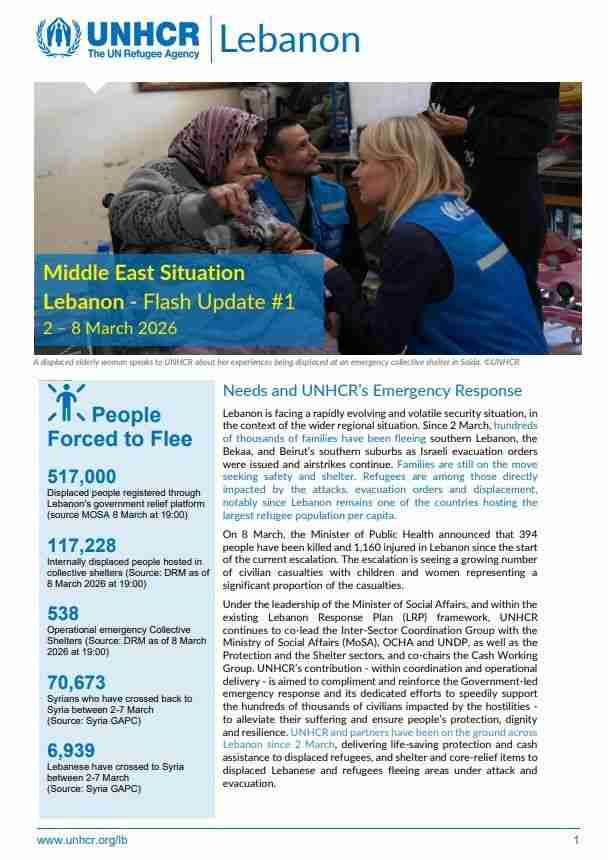





The Lebanon Humanitarian Flash Update #3 was published on 12 March 2026 by UNICEF. The report outlines the humanitarian situation affecting children and families following the escalation of hostilities in Lebanon and details UNICEF’s multi-sectoral emergency response. It aims to inform immediate response efforts and highlight urgent needs across protection, education, health, and basic services.
Key insights:
Approximately 816,700 people have been displaced, including an estimated 285,600 children, with many facing repeated displacement and limited shelter options.
At least 91 children have been killed and 275 injured, while ongoing airstrikes continue to expand displacement and increase risks to civilians.
Over 590 collective shelters are operating at near full capacity, while many families are forced into informal or unsafe living conditions, including unfinished buildings and public spaces.
Education has been significantly disrupted, with 344 public schools converted into shelters, affecting more than 100,000 students.
Critical infrastructure, including water systems and pumping stations, has been damaged, reducing access to safe water for tens of thousands of people.
UNICEF has scaled up emergency response across sectors, including WASH services for over 46,000 people, distribution of relief items to nearly 63,000 individuals, child protection interventions in shelters, and mobile health services.
UNICEF requires US$48.29 million for its three-month response, with a funding gap of approximately 91%, threatening the continuity of essential services.