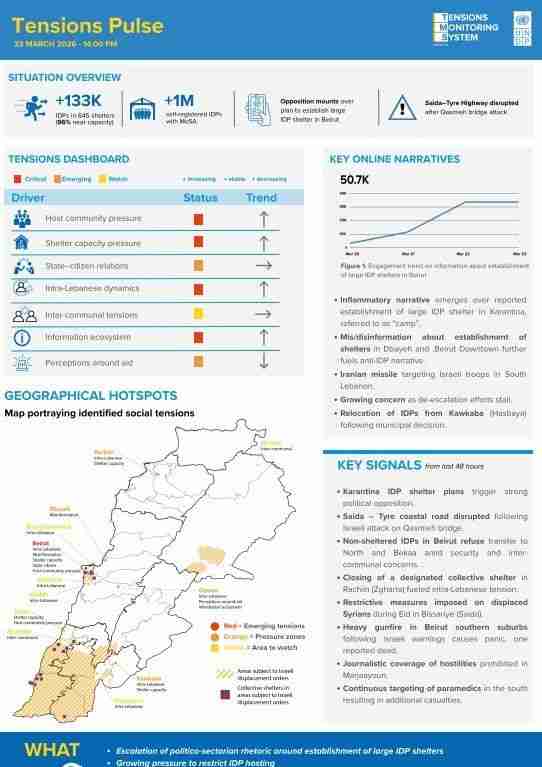





Lebanon Flash Update No. 7 was published on 11 March 2026 by the United Nations Office for the Coordination of Humanitarian Affairs (OCHA) Lebanon Office, in collaboration with the Inter-Sector Coordination Group under the 2026 Lebanon Response Plan framework. The report provides an overview of the rapidly deteriorating humanitarian situation caused by the escalation of hostilities in Lebanon, with a focus on mass displacement, civilian casualties, pressure on shelter systems, and the urgent scaling up of humanitarian response. It aims to support immediate response planning and highlight the growing operational and funding pressures facing humanitarian actors.
Key insights:
More than 816,700 people had self-registered as displaced by 11 March, while 125,800 people were reported in 580 collective shelters, though the actual figure was likely higher due to unregistered shelters and the large number of displaced people staying outside formal sites.
At least 634 people had been killed and 1,586 injured since the escalation began on 2 March, placing severe strain on Lebanon’s already overburdened health system.
Displacement patterns were becoming more complex, with new displacement orders affecting 11 locations in Saida and Tyre, triggering repeated and secondary displacement and increasing pressure on host communities and temporary shelter options.
More than 78,000 Syrians and over 7,700 Lebanese had crossed into Syria since the escalation began, reflecting the regional spillover of the crisis.
Humanitarian response was scaling up, including the opening of additional shelters in Beirut, but capacity remained insufficient and assistance pipelines were under strain, with OCHA warning that without timely funding, life-saving support would become harder to sustain.