


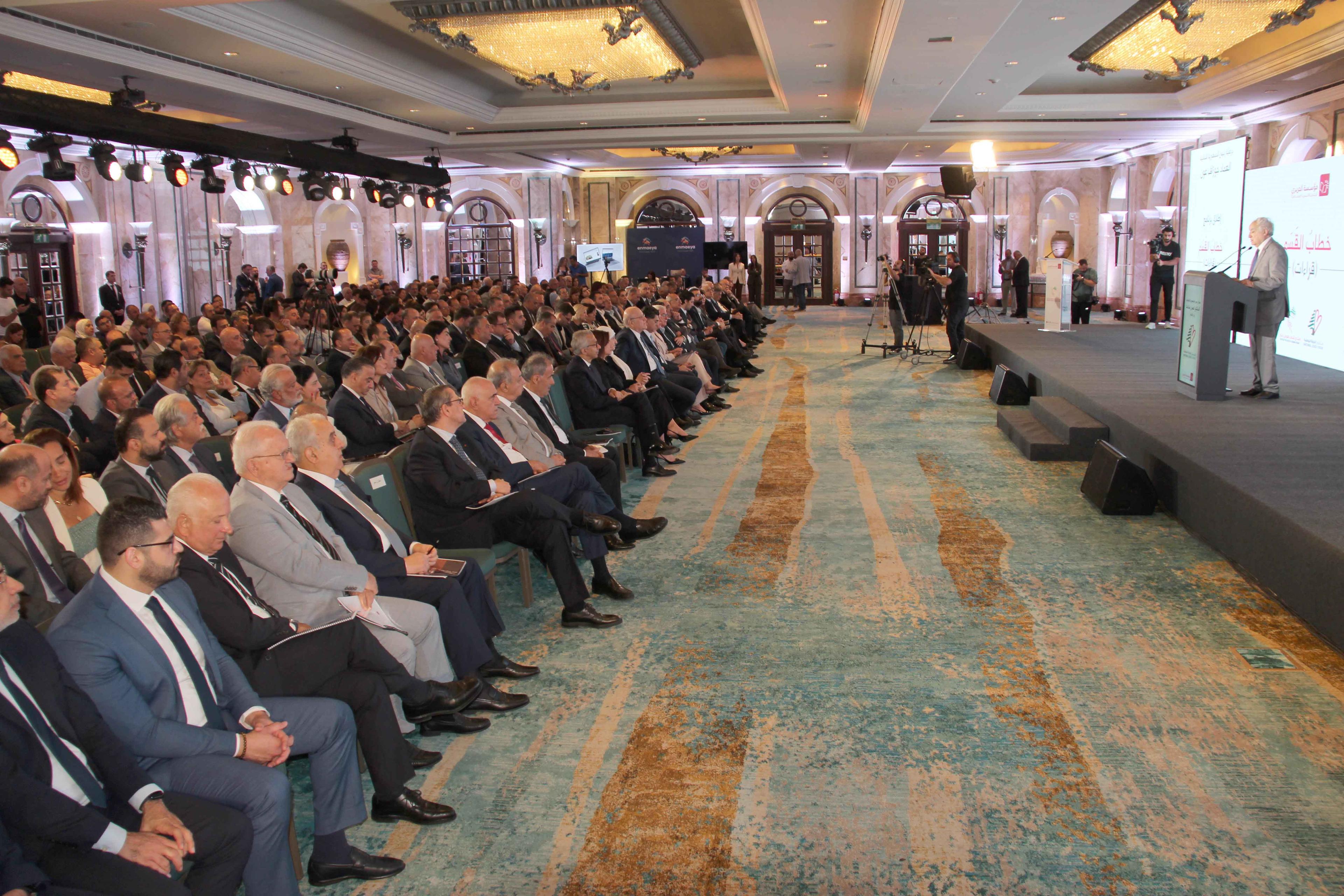
Beirut, Lebanon (Enmaeya News) — Under the patronage of the President of the Republic of Lebanon, His Excellency General Joseph Aoun, the Hariri Foundation for Sustainable Human Development, in collaboration with the National State Forum and the Youth Forum for Lebanon’s Advancement, and in media partnership with Enmaeya, organized a national event titled “Readings in the Inaugural Speech” on Friday, June 13, 2025, at the Phoenicia Hotel – Beirut.
The event was attended by H.E Minister Ghassan Salamé, representing the President; H.E Former Prime Minister Najib Mikati; H.E Minister of Economy Amer Bsat; H.E Minister of Information Paul Morcos; members of parliament; and various union, academic, sectoral, and student figures.
The event aimed to raise public awareness of the content of the inaugural speech and to involve citizens in fulfilling its goals—considered a strategic vision that speaks to all generations across Lebanon.
In this context, H.E Mrs. Bahia Hariri stated:
“The Youth Forum for Lebanon’s Advancement, in partnership with the National State Forum, the Democracy Education Program, and the Enmaeya platform, is launching the ‘Readings in the Inaugural Speech’ program. We look forward to the participation of universities, sectoral unions, civil society, youth movements, and regional communities.”
The National State Forum introduced the concept of “readings” as a scientific analytical tool to deconstruct official and political texts, specifically the President’s inaugural speech. According to the forum’s youth members, the “readings” approach combines both quantitative and qualitative analysis to extract precise meanings and understand deep contextual layers. The methodology uses tools such as Discourse Analysis, Issue Frequency, Text Mining & Network Analysis, and generative AI to enhance findings.
The Youth Forum presented a sample of in-depth analysis, revealing that the speech focused on three main terms, repeated over 12 times each: Lebanon (40 times), Oath (27 times), State (12 times).
The speech emphasized building a strong state:
“A state committed to the rule of law, reliant on institutional integration to safeguard the homeland, bolster the economy, advance development, and protect national borders. A state that promotes public order, adheres to the law, builds the economy, guarantees rights, confronts occupation, and preserves sovereignty.”
The speech included 112 pledges, categorized into 23 sub-goals, distributed across five main pillars: Political and Administrative Reform, Economy and Development, Justice and Human Rights, Security and Defense, Foreign Relations.
To support the fulfillment of these commitments, the forum presented sectoral readings grounded in 24 reports and 22 digital platforms, incorporating both quantitative and qualitative indicators that reflect challenges and opportunities in the sectors mentioned in the speech. The presentation assessed the impact of the presidential vacancy since 2022, institutional realities, and the ramifications of the recent Israeli war—highlighting their intersections with the inaugural speech.
Former Minister Bahia Hariri stressed that the initiative continues the foundation’s efforts to transform the inaugural speech into a roadmap for reform and recovery, noting:
“Lebanon’s school taught us the most bitter lessons, foremost of which is distinguishing between crisis-management rhetoric and challenge-confrontation rhetoric. We paid a high price when we ignored the extraordinary, creative energy of Lebanon’s generations.”
She affirmed that Lebanon’s future begins with respect for its people:
“Lebanon’s future lies in investing in its people—the deeply rooted and renewable wealth across generations—who have proven their worth at home and abroad. The least we can do to preserve this promise is to respect their minds, their abilities, and speak to them as intelligent partners in shaping national decisions.”
She added that January 9, 2025, the day of the presidential election, was more than symbolic—it marked a national turning point:
“It was the beginning of our transition from crisis management to the restoration of national confidence and institutional order.”
She called the inaugural speech a pact, a commitment, and a sincere self-reflection, aligning with the new government’s rescue and reform agenda. She announced the launch of “Sidon Discusses the Ministerial Statement,” a four-week workshop in collaboration with doctors’ and engineers’ syndicates and student and academic leaders.
Hariri noted that the team behind the "Readings" project presented their findings to the President, who expressed support and appreciation for their effort.
On the choice of venue, she said:
“We wanted our gathering on Friday, June 13 to be in Beirut—the unbreakable capital—at the Phoenicia Hotel, a symbol of Beirut’s phoenix-like resilience and memory of rebirth.”
She concluded:
“Today, Lebanon needs its intellectual, cultural, political, educational, economic, social, and digital forces—to launch a national initiative to reorder our priorities and rebuild the national identity of the rising generation, grounded in respect, capacity, and renewed faith in Lebanon.”
Mrs. Hariri also honored the President’s representative, Minister of Culture Dr. Ghassan Salamé, with the “Phoenix Award” from the Youth Forum for Lebanon’s Advancement in recognition of his attendance and contributions.
In his speech, Dr. Ghassan Salamé said:
“The President was kind enough to entrust me with representing him at this event, which he holds dear.”
He emphasized the importance of revisiting and deconstructing the inaugural speech using content and discourse analysis, saying:
“This signals both the significance of the speech and that its impact did not end when it was delivered—it continues to resonate.”
He saluted Mrs. Bahia Hariri and the Foundation:
“I commend Mrs. Bahia Hariri and the Foundation team for, once again, setting aside regional tensions and focusing our minds on this important speech.”
He added:
“Part of our collective identity lies in our ability to process bad news, learn from it, and adapt.”
He emphasized that enhancing Lebanon’s resilience is a top priority, and that it requires a capable, just state that protects the vulnerable, regenerates wealth, and ensures its fair distribution.
Dr. Salamé noted that the word “state” appeared 12 times in the inaugural speech and 24 times in the ministerial statement. He observed:
“We live in a hybrid relationship with our state—on one hand, we thirst for its presence and prestige, and on the other, we distrust it.”
He asserted that the current challenge is to bridge that distrust and rebuild confidence, emphasizing:
“There is no alternative to the state.”
He warned that the decline of state power over the past decades created a vacuum filled by organized interests and forces outside the state.
He clarified:
“Reinvigorating state authority requires more than a decree—it means confronting and displacing unauthorized powers that have entrenched themselves in our public life.”
He continued:
“In every sector, we find something resembling a cartel that has taken over. Rebuilding the state requires firm resolve. The state’s rights must no longer be ignored.”
He described the inaugural speech as a guiding light, adding that the government program is a daily action plan aligned with it.
He also stressed the need for unity in the executive authority, warning against weak and ineffective governance:
“We cannot afford diluted authority. Some may admire regimes where decisions are made and implemented in an hour—but do they want us to abandon our institutions, our constitution, judiciary, parliament? We will not.”
He concluded:
“We live in a democracy, and we are committed to it. Yes, our decisions may take time, but we must strike a balance between respecting institutions and making timely decisions. This is the equilibrium we’ve yet to achieve—and we must work toward it.”
“Our pledges in the inaugural speech and ministerial statement are not just ink on paper. They are a roadmap that we will pursue until fully implemented.”
The event was held in response to the President’s call to strengthen national dialogue and reinforce unity and stability in Lebanon during this pivotal time. Through such initiatives, the Hariri Foundation reaffirmed its commitment to constructive dialogue, sustainable human development, and the empowerment of youth as key partners in shaping Lebanon’s future.