







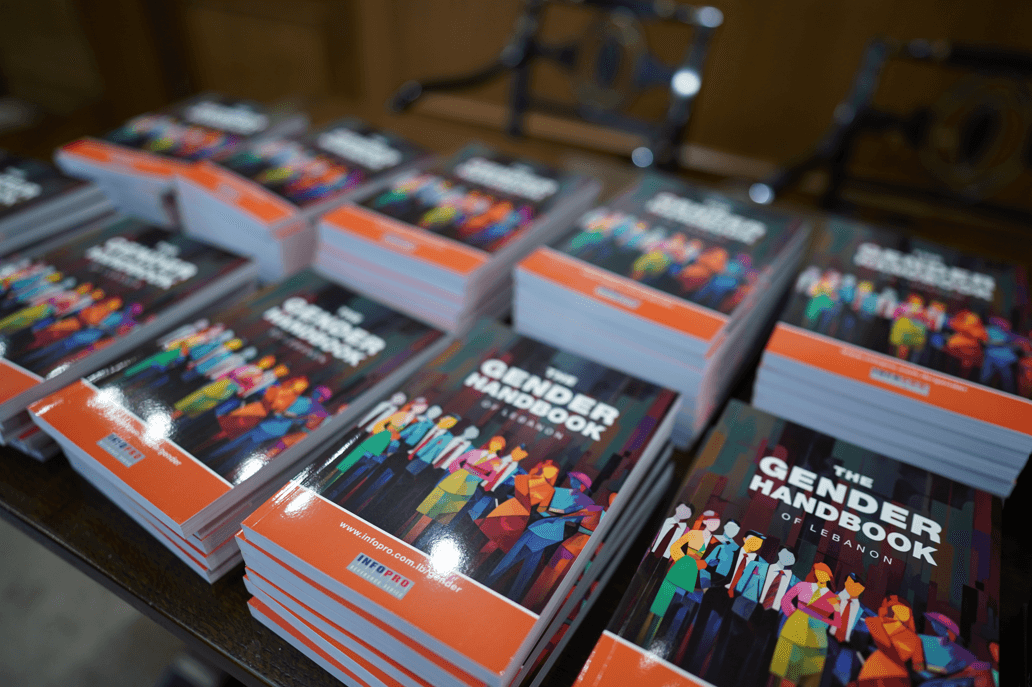
Beirut, Lebanon (Enmaeya News) — An event spotlighting gender equality effort in Lebanon took place Tuesday, June 17, at Le Gabriel Hotel in Beirut, bringing together policymakers, researchers, and international development leaders for the official launch of The Gender Handbook in Lebanon.
The handbook is designed to support gender mainstreaming across public policy, development initiatives, and social programming. It offers a comprehensive overview of gender gaps in Lebanon, focusing on six key areas: livelihood, education, health, gender-based violence, the legal framework, and women’s participation in the public and political sectors.
In his opening remarks, publisher Ramzi El Hafez emphasized the urgency of addressing gender disparities, noting Lebanon’s alarmingly low ranking in global gender indexes.
“Despite years of work and multiple studies, we’re barely moving,” El Hafez said. “Lebanon is stuck near the bottom—136 out of 148 globally. Even when progress is made, it’s not enough to catch up.”
El Hafez revealed that the handbook drew from more than 150 credible studies by international institutions, NGOs, and academic centers.
“We focused strictly on facts and findings,” he noted, “intentionally avoiding prescriptive remedies to maintain objectivity.”
He also pointed to key challenges in compiling the data: outdated studies, conflicting results, and limited national coverage.
“Some reports claim to be comprehensive but are actually based on informal or partial samples,” El Hafez explained. “Even studies from reputable organizations conducted around the same time often produced contradictory conclusions.”
To ensure sustainability, the project launched an accompanying online platform housing the full content of the handbook along with extensive additional resources. These include categorized studies, statistics, and a directory of organizations working on gender issues in Lebanon.
Detailed Insights: Unpacking Lebanon’s Gender Gaps
Jennifer Abu Mrad, the Lead Researcher of the book began with the critical topic of livelihoods, highlighting how the economic crisis has deepened poverty in Lebanon — especially for women-led households, which face more severe food insecurity than men-led households. This disparity is particularly acute in rural areas and among households with young children, where poverty rates for women-led families are two to three times higher than their male counterparts.
She underscored that women’s vulnerability is tightly linked to labor market challenges and societal roles. Although women constitute 53% of Lebanon’s working-age population, their labor force participation remains low at 22%, compared to 66% for men. Even more starkly, only about 15% of women are actually employed.
Abu Mrad explained labor force participation is highest for women aged 25-29 but drops by half after they have children, recovering only once their children finish compulsory education. Rural women face additional barriers as jobs are scarce and often reserved for men, viewed as primary breadwinners while women are caretakers.
She highlighted the concentration of women in stereotypical service sectors such as education and health, which limits their economic empowerment. Despite being more educated than men overall, women are vastly underrepresented in managerial roles — only one woman holds a managerial position for every 10 men. Entrepreneurship is similarly limited, with just 10% of companies having a female owner and only 5% majority-owned by women.
Financial inclusion remains a key hurdle. In 2018, 50% of women had bank accounts versus 70% of men; post-crisis, this dropped drastically to about 17% of women. Many women rely on informal and often unsafe borrowing channels. Additionally, financial literacy is low, with only 25% of women considered financially literate compared to 45% of men.
Regarding education, Lebanon has made progress, achieving near parity in access to education, with girls often outperforming boys academically. Enrollment rates in secondary and tertiary education favor girls, and younger women show markedly lower rates of undereducation compared to older generations. However, youth unemployment remains high, especially among young women not in employment, education, or training (NEET), with rates reaching nearly 50% in some rural regions.
Abu Mrad pointed out a concerning trend: educational curricula tend to steer girls toward stereotypical fields, limiting their future economic participation.
On health, she noted coverage is generally equitable, but inequalities emerge with age, marital status, and disability. Poor women-led households face significant challenges accessing medication and healthcare services, with transportation barriers compounding these issues.
Lebanon has met the Sustainable Development Goal targets for maternal mortality overall, but disparities persist between regions and between Lebanese nationals and Syrian refugees, whose maternal mortality rates are higher. Post-crisis, maternal mortality has unfortunately increased among Lebanese women due to deteriorating healthcare access.
Sexual and reproductive health services have improved but remain inaccessible or stigmatized for unmarried women.
Abu Mrad also tackled the critical issue of gender-based violence (GBV), revealing that 37% of women and girls in Lebanon have experienced physical or sexual abuse. Underreporting remains widespread due to stigma and fear. Despite recent legislation criminalizing sexual harassment, trafficking, and domestic violence, significant gaps remain, including the lack of a legal minimum age for marriage and loopholes that allow perpetrators to escape justice.
Legal and Political Challenges
In the public and political spheres, progress remains painfully slow. Lebanon has closed just 3% of the gender gap in political participation, compared to near parity in education and health.
Women represent only 21% of the public sector workforce, mostly concentrated in education, with scant presence in security forces and politics. In the 2022 parliamentary elections, only 6% of successful candidates were women, although female candidates have higher success rates in municipal elections.
Abu Mrad stressed that Lebanon’s political and legal systems perpetuate discrimination — not only through explicit laws like the nationality law denying women the right to pass citizenship to their children but also through patriarchal social norms that view women as caretakers rather than leaders.
Structural barriers include gender-biased labor laws, social security gaps, tax discrimination, and a lack of gender-sensitive policies in education curricula. Media portrayals further reinforce stereotypes, emphasizing personal qualities over leadership skills for women politicians.
Community acceptance of GBV, stigmatization of victims, inadequate resources for survivors, and insufficient gender-sensitive investigations compound these challenges.
Panel Discussion Highlights
H.E. Minister of Social Affairs, Haneen Sayed expressed strong support for the handbook, calling it a crucial public good that the government itself should be providing. She stressed Lebanon’s severe data deficiencies, calling it “the most data poor country in the world,” which hampers policymaking on gender issues. Sayed highlighted the fragmented and inconsistent nature of existing data, citing challenges such as resource scarcity and governance issues within the Central Administration of Statistics (CAS).
She affirmed the Ministry of Social Affairs’ readiness to collaborate on updating and expanding gender data collection, including pushing for essential national surveys such as the population census and household budget surveys with gender disaggregation. Sayed also emphasized the need for reforms in data access regulations to ensure that data become publicly available for researchers and policymakers, turning statistics into tools for informed debate and evidence-based decision-making.
Blerta Aliko, UNDP Resident Representative in Lebanon placed Lebanon’s gender data challenges within the framework of the Sustainable Development Goals (SDGs), noting that out of approximately 80 gender-related indicators, only 12 are systematically collected by national institutions. She highlighted the gap between data availability and its effective use in policymaking.
Drawing on her experience in other countries, Aliko stressed that policy progress depends not just on data but also on political will and institutional capacity.
She pointed to the problem of data interoperability — the lack of standardized methodologies and harmonization — which complicates efforts to interpret and use gender data consistently.
Aliko underscored the importance of integrating gender considerations into national budgeting processes, including recognizing unpaid care work in economic metrics and social compensation, thereby linking gender data to concrete policy outcomes in education, social protection, and fiscal planning.
Gielan El Messiri, UN Women Representative in Lebanon, focused on the institutionalization of gender data within Lebanon’s national statistical system. She advocated for a comprehensive national statistical strategy that prioritizes the production and use of gender-disaggregated data across all government ministries, including social affairs, finance, and agriculture.
El Messiri highlighted the value of administrative data, such as the upcoming agricultural census, as an often underutilized but important source of gender statistics.
She also called for capacity building and enhanced coordination within the Central Administration of Statistics, praising the talents present there despite challenges, and stressing the urgent need for increased funding and support.
El Messiri linked the issue to Lebanon’s international commitments under SDG5 on gender equality, noting the importance of systematic reporting and data-driven accountability at the regional and global level.
Together, the panelists underscored the vital role of reliable, accessible, and harmonized gender data as a foundation for effective policies, accountability, and sustainable development in Lebanon.
The launch is expected to spark broader national dialogue on closing Lebanon’s gender gaps and create a shared reference point for future interventions.