







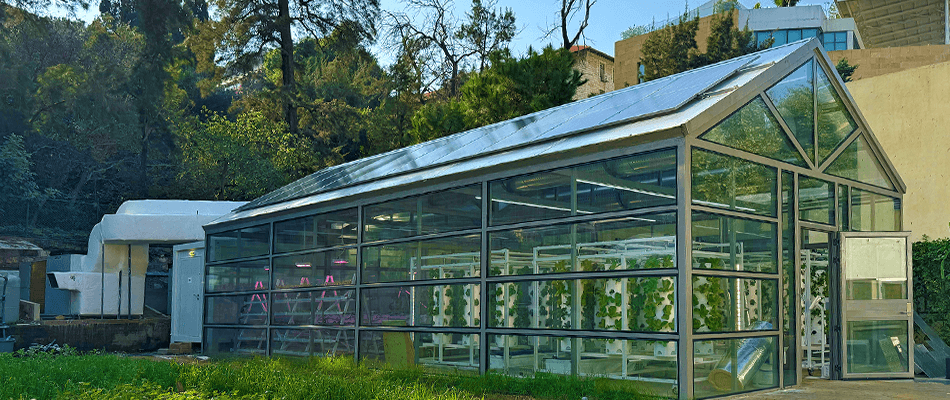
Beirut, Lebanon (Enmaeya News) — A small 72-square-meter solar-powered glasshouse at the American University of Beirut is leading a quiet farming revolution. It houses Lebanon’s first fully automated hydroponic system, combining vertical farming, Nutrient Film Technique, and gutter systems.
As temperatures rise and water scarcity grows, traditional farming faces increasing challenges, especially in the Global South. Vertical farming offers a resource-efficient alternative and a potential buffer against climate uncertainty.
“Climate change is a fact. Vertical farming, whether open-air or fully controlled, gives us a way to adapt,” said Professor Walid El Kayal, who developed the project with his team at AUB’s Faculty of Agricultural and Food Sciences. “We can grow food even when the environment becomes hostile.”
The farm currently produces about 2,300 plants, including basil, kale, lettuce, arugula, baby spinach, green peppers, tomatoes, and strawberries.
Funded by the European Union’s PRIMA program under the BONEX initiative, the facility serves as both a research hub and a proof-of-concept model for agriculture in regions facing environmental and economic pressures.
“The project isn’t just about farming smarter,” El Kayal said. “It’s about democratizing access to the tools of resilience in low-resource regions that lack the financial resources to face climate change head-on.”
El Kayal, an agricultural expert with experience in France and Canada, designed the farm around three advanced systems: vertical rotating towers, Nutrient Film Technique pipes, and gutters for vine crops like tomatoes and strawberries.
Each system serves a specific purpose — rotating towers and Nutrient Film Technique are suited for leafy greens, while gutters are ideal for vine crops.
Despite the farm’s high-tech setup, including app-controlled automation and 22 solar panels, El Kayal is most enthusiastic about its flexibility.
“We created a spectrum,” he said. “Yes, what we have here at AUB is the most advanced version, but we’re also testing lower-cost systems with fewer automated features, so it’s accessible to communities with limited infrastructure and financing.”
This flexibility is already being tested at AREC, AUB’s agricultural project in Lebanon’s Beqaa Valley. There, a simpler, less automated version is operating successfully with fewer resources, producing strong yields for staple crops.
It shows vertical farming doesn’t have to be expensive to be effective and scalable — a key factor for adoption in regions most in need but often lacking financial means.
To build that future, El Kayal and his team are training students, industry partners, and public stakeholders.
“We invite people to workshops,” he said. “We explain that you don’t need full automation. You can save thousands by operating manually — using basic tools to measure nutrients instead of sensors and switching off automated features.”
As the global climate continues to change, AUB’s vertical farming project offers a promising blueprint — not just for Lebanon but for all climate-vulnerable regions.