


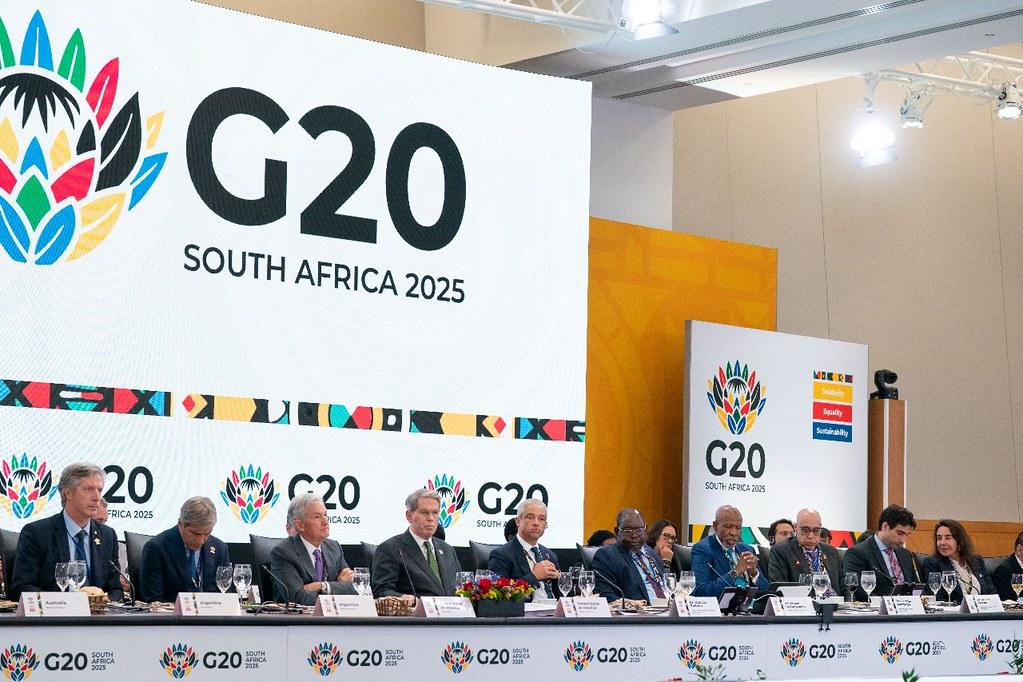
London, United Kingdom (Enmaeya News) — The G20’s financial stability watchdog delivered a new plan Monday on tackling climate-related financial risks but paused further policy work amid a U.S. retreat that has tested efforts to advance a unified global response.
The U.S. has withdrawn from multiple groups exploring how flooding, wildfires and major climate policy shifts could affect financial stability.
In its medium-term plan, the G20’s Financial Stability Board pledged to step up coordination and data sharing on climate-related financial risk.
However, it said some members, including central bank governors and finance ministers, “feel that the work completed to date is sufficient” and expressed a desire to pause further climate work.
“While many members feel there is a need for more work, some members feel that the work completed to date is sufficient,” the FSB said in an update to its 2021 climate roadmap delivered to G20 finance ministers meeting in South Africa.
“Going forward, the FSB will … make determinations about what projects, if any, it will undertake.”
U.S. Treasury Secretary Scott Bessent did not attend the G20 meeting, Reuters reported last week. The U.S. is scheduled to lead the G20 next year, a group it helped found after the global financial crisis.
The FSB said it will continue to consider climate-related topics each year and focus on its role as a coordinator of international work on climate risks.
It added that it has no plans for significant new policy work on integrating climate-related financial risks into its supervisory and regulatory framework, noting ongoing work at many member institutions.
Brussels-based think tank Finance Watch criticized the lack of reference to concrete regulatory measures as a sharp retreat from the G20’s original ambition and a sign of multilateral backsliding.
“It confirms what we’ve been hearing since the G20 Plenary in Madrid (in June): the FSB is backing down under pressure, especially from the U.S.,” the group said in a statement.
“If the G20 endorses this shift, we risk locking in a fragmented response. That weakens incentives for lagging jurisdictions (and) reduces multilateral pressure to act,” Julia Symon, head of research and advocacy at Finance Watch, added.
Earlier this year, the FSB published work on the usefulness of transition plans for financial stability and presented a stocktake of supervisory and regulatory work on nature-related financial risks.
“Rather than identifying such vulnerabilities a priority for further work, the FSB will leave that decision up to its annual work programme process,” the report said.
The report also detailed progress made since 2023 by international standard setters and global banking regulators.