



Beirut, Lebanon (Enmaeya News) — The AI in Lebanon Conference 2025 officially opened Monday at the MEA Conference Center in Beirut, convening over 30 speakers from around the world to explore how artificial intelligence is transforming sectors including education, health, governance, infrastructure, and public services.
The two-day Beirut leg, held July 21–22, kicked off a six-day national conference that will continue in Tripoli, Sidon, Zahle, and Aley through July 26. Organized by Future10X, the conference is held under the patronage of Dr. Kamal Shehadi, Minister of the Displaced and State Minister for Technology and AI.
In his opening keynote, Shehadi called for “a strategic national commitment” to AI-driven development, asserting that artificial intelligence “is no longer a choice—it has become a key pillar in shaping the destiny of nations.” Emphasizing inclusivity, he added, “From Tripoli to Sidon, from Aley to the Bekaa plain... the AI bus must travel across Lebanon to spread awareness.”
He also urged institutional reform, declaring, “The moment has come to establish a Ministry of Technology and Artificial Intelligence in Lebanon,” envisioning a “digital administrative republic” that is more transparent, responsive, and effective in public service delivery.
The opening session featured a lineup of public officials and academics. Former Minister of Information Manal Abdel-Samad spoke about the evolving role of technology in governance, noting, “Technology is not the end goal; it’s a tool that helps us do what we’ve always done—only better.” Addressing workforce transformation, she added, “There are 83 million technology-related jobs, of which 69 million are new,” underlining the need to adapt to rapid global change.
Former MP Dima Jamali highlighted AI’s role in education and sustainability, while former Tripoli mayor Nader Ghazal discussed smart cities and the future of municipal leadership. Health expert Mohammed Al Masri explored how AI can help ease pressure on Lebanon’s strained healthcare system.
Technical presentations followed, featuring insights from Alaa Dalghan, Dr. Hatem Sleem, Wassim Hassanieh, Ed Sleiman, and Mohamad Fawaz. Topics ranged from AI in education to cybersecurity and sustainable development.
Higher education expert Yousif Asfour, legal specialist Nada Abdelsater, and digital strategist Talal Jaber spoke about integrating Lebanese institutions into the AI ecosystem. Omar Kaskas presented on grassroots tech initiatives, emphasizing how tools like ChatGPT can enhance community impact through innovation and efficiency.
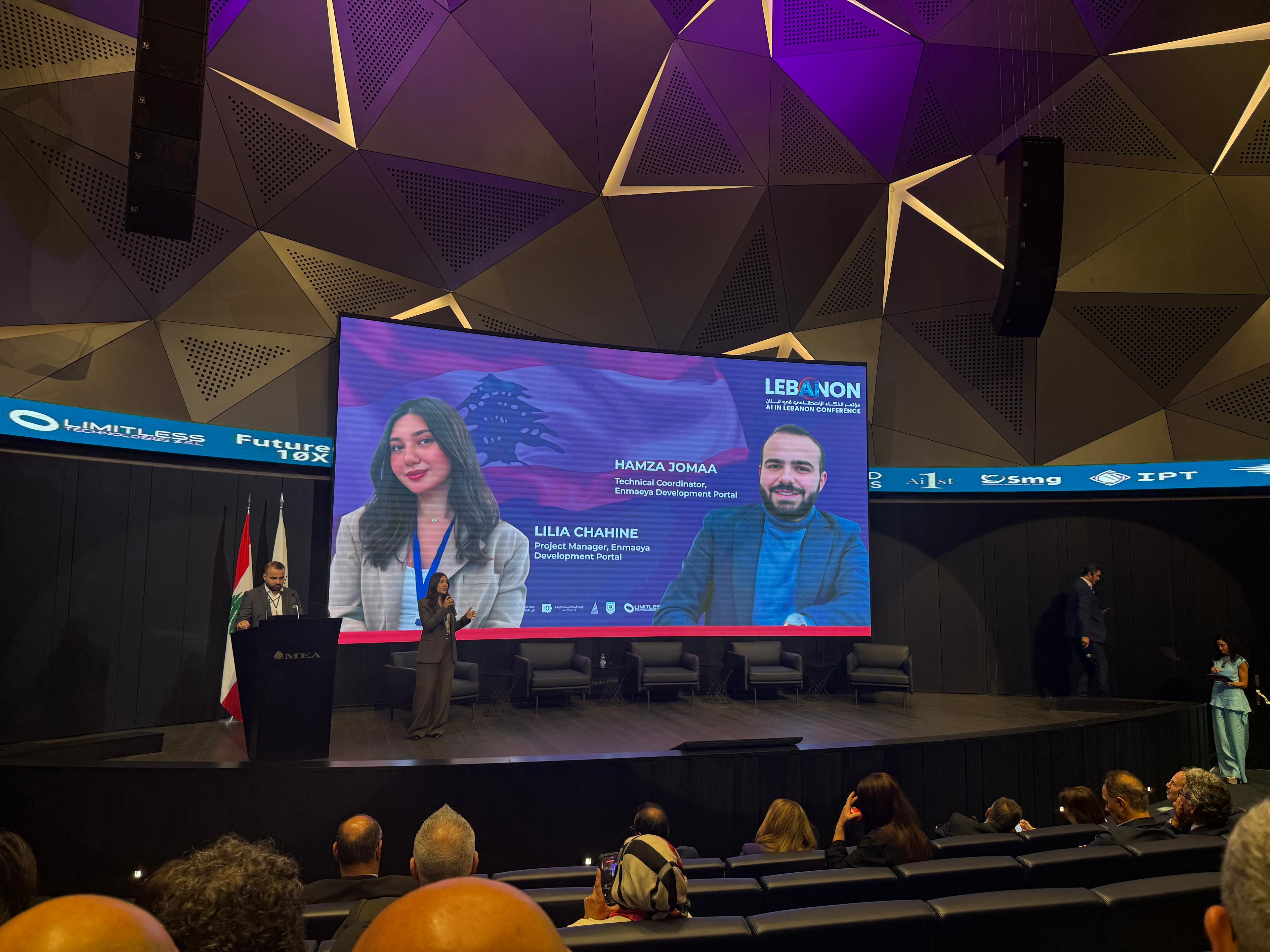
Enmaeya’s team — Lilia Chahine and Hamza Jomaa — took the stage to present the Enmaeya AI Agent, a custom-built AI chatbot trained on development-focused data. Designed to improve user engagement and information access, the chatbot can respond to report-based queries, detect trends across key sectors such as AI, education, health, environment, and the economy, and link users directly to relevant resources from Enmaeya’s Knowledge Hub.
Tuesday’s sessions featured speakers including Fadi Zuhayri on global AI collaboration, Firas Sleiman on Arabic-language systems, Labib Nasr on AI applications in insurance, and Hicham Jaouhari on cloud infrastructure.
Cultural performances and interactive workshops followed, along with panel discussions focused on education and social development. Panelists included Georges Khoueiry, Claude Margi, Dr. Sally Hammoud, Dr. Hatem Sleem, and Salma Dannawi Oueida. Andrew Maroun delivered a keynote on automation and chatbot solutions.
The conference will continue in Tripoli on Wednesday, followed by sessions in Sidon, Zahle, and Aley through July 26. Upcoming discussions will expand into tourism, agriculture, telecommunications, and AI policy.
President of Future10x, Dr. Hikmat Beaini closed the Beirut leg with the story of how the event began—an idea that was sparked at a previous AI gathering in Dubai. “No obstacles, no money, no resources… but if you rely on people who love you, every impossible becomes possible,” he said, crediting the dedication of friends, sponsors, and government support. “If your family is with you, nothing matters. If your friends are with you, nothing matters. And if the government is with you, nothing matters.”