




BEIRUT (Enmaeya Press Release) - November 19, 2025
Speaking at the Beirut One Conference, Minister of Technology and Artificial Intelligence Kamal Shahadi outlined Lebanon’s vision for a competitive, future-ready digital economy, highlighting both the opportunities and challenges ahead.
Minister Shahadi noted that AI-driven labor productivity has risen by 40%, with 50-70% of companies worldwide expected to integrate AI into their operations. However, he cautioned that 80% of organizations have failed to see returns on AI investments, a trend he believes is improving as the industry matures.
“Just today, a major data-center operator told me they are looking to hire 500 additional employees from Lebanon,” Shahadi revealed, emphasizing that companies leveraging AI are becoming more competitive. “The question for us is simple: How do we make Lebanon more competitive?”
Strengths and Challenges
Shahadi highlighted Lebanon’s exceptional talent, its dynamic and globally engaged diaspora, and its strong entrepreneurial, problem-solving culture, noting that “Lebanese people are born problem-solvers.”
At the same time, he pointed to pressing challenges, including outdated laws and regulations, particularly around digital business, cybersecurity, and data privacy. Draft legal frameworks are now being prepared for submission to the Council of Ministers.
Another major concern is the continued migration of skilled talent, with many graduates leaving shortly after earning their degrees. “Our challenge is to turn Lebanon into a global destination for launching and scaling businesses,” he stated.
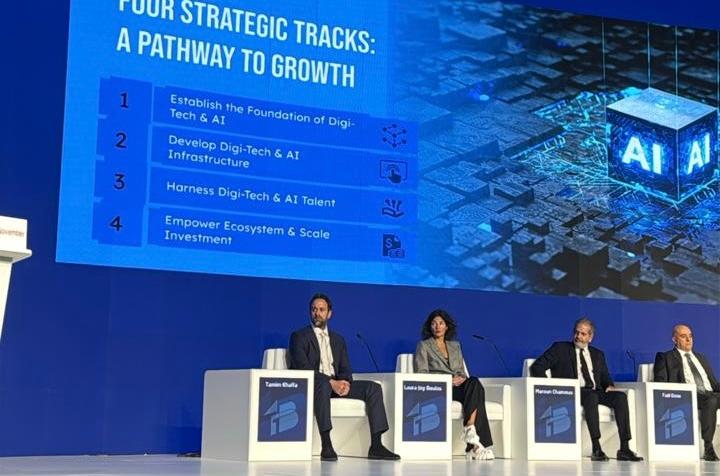
Four Strategic Tracks
The minister outlined four priority tracks, including: establishing the foundation of Digi-Tech and AI, developing Digi-Tech and AI infrastructure, harnessing Digi-Tech and AI talent, and empowering the ecosystem while scaling investment.
The minister discussed modernizing Lebanon’s legal and institutional frameworks for the digital age, upgrading national digital infrastructure, expanding the tech talent pipeline from 3,500 to 10,000 graduates while ensuring inclusivity across all ages, and empowering the broader innovation ecosystem.
The minister emphasized the importance of national programs that make technology and AI accessible regardless of location, gender, or age.
“Even people in their 50s and 60s must be included; they remain productive contributors to the economy,” Shahadi stressed.
Key Projects Announced
Shahadi highlighted several national initiatives, including the $200 million Digital Renaissance Fund, aimed at financing and scaling Lebanese tech companies, supporting corporate digital transformation, and advancing digital public-private partnerships.
He also pointed to the expansion of data centers driven by the private sector, the development of a national digital infrastructure in collaboration with the Ministry of Interior to form the backbone of digital government, and the creation of actionable government databases designed to transform ministry data into tools that enhance policymaking and improve service delivery.
Shahadi also disclosed strong private-sector interest: 30 companies have indicated $2.2 billion in potential investments, including $1 billion earmarked for technology.
“I believe Lebanon’s digital renaissance begins here,” he concluded, expressing optimism over the growing enthusiasm across the private sector and global partners.