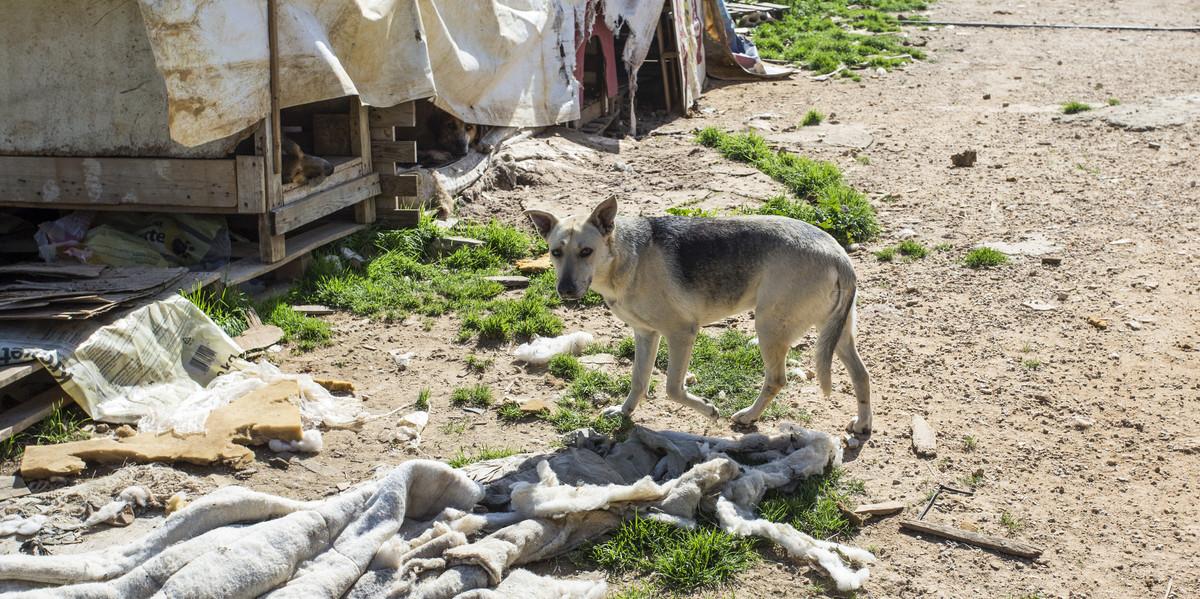
LEBANON - Amid the chaos of war, displacement, and systematic destruction in southern Lebanon, local rescuers scramble under life-threatening conditions and with limited resources to save animals, both those abandoned by displaced families and stray animals left to fend for themselves.
Merely a few kilometers from the border strip, these rescue workers navigate streets often reduced to ruins, delivering food, medical care, and a lifeline to animals left behind.
Every Rescue Counts
While official statistics on the number of abandoned animals in southern Lebanon are unavailable, rescue workers told Enmaeya that the numbers are estimated to be in the hundreds.
For these rescuers, every mission is a small victory against overwhelming odds. Hussein Hamze, a rescuer from Zefta, recalled his early experiences with animals during the 2006 conflict.
“In 2006, I stayed alone in the village where people left animals, cats, dogs, and birds, with me,” he told Enmaeya. “One night, a dog that had been tied on the balcony started barking while I was asleep, alerting me just as a missile hit nearby. In a way, that dog saved me.”
“That experience stayed with me,” Hamze continued. “Often, when we are unable to save an animal, or they are trapped under the rubble, it leaves a deep impact, but it also makes you more dedicated.”
Today, he travels through southern Lebanon’s war-torn villages, rescuing animals whenever and wherever he can. “We take the animal, castrate and vaccinate, deworm, and set them up for adoption,” he explained.
Kassem Haidar, another rescuer operating across southern Lebanon, has seen firsthand how these efforts can save lives and inspire communities. “It started when I rescued a dog from a war zone in Mais Jabal and sent him to Canada for adoption,” he told Enmaeya.
Haidar’s work, like Hamze’s, moves in stages. “First, we rescue animals from war zones, then we move them to veterinary clinics, and finally to shelters or adoptive homes,” he explained.
“In war zones, animals are often the most forgotten victims. Our job is to give them a chance at life and to remind people that every life matters,” Haidar told Enmaeya.
Social Media as a Lifeline
For both Hamze and Haidar, social media has become a lifeline in their rescue efforts. Hamze explained that online donations help him secure food, medical supplies, and essential care for animals, while posts and videos amplify the message about abandoned pets.
“It allows us to expand our network, but sometimes people share footage of animals and ask me to step in, and it’s not always possible,” he said.
Haidar echoed this, noting that social platforms not only mobilize support and donations but also connect animals with potential adoptive homes. “Social media has mobilized people, support, and donations, and expanded the network,” he said, emphasizing that these digital tools turn isolated acts of rescue into a wider movement of awareness and action.
A Call for Compassion
Both Hamze and Haidar stress the need to teach compassion for animals and urge people never to abandon them, even in the hardest of times. Their work in southern Lebanon stands as a testament to the difference that care, commitment, and awareness can make in saving lives left behind by war.