ARAB WORLD - The number of educated women in the Arab region has risen exponentially over the past few decades. However, despite massive investments in female education, resulting in higher tertiary attainment than men in several Arab countries, women in the region experience among the lowest labour force participation rates in the world. Researchers have used the term "MENA education paradox" to describe this.
Against this backdrop, a question arises: do Arab women actually want to work? Evidence suggests they do. The ILO found that 70% of women surveyed preferred paid employment regardless of their current employment status. The barrier, then, is not desire.
What the Numbers Reveal
Globally, the average female labour force participation rate stands at around 48%, compared to 75% for men. In contrast, in the Arab region, the average female participation rate is half of that average, recorded at 25.5%.
Arab States excluding the Gulf Cooperation Council (GCC) have the lowest female labour force participation rate in the world at just 11.7%, compared to 66.2% for men, according to the ILO's World Employment and Social Outlook 2024. When GCC countries are included, the rate rises to 25.5%, remaining the second lowest globally.
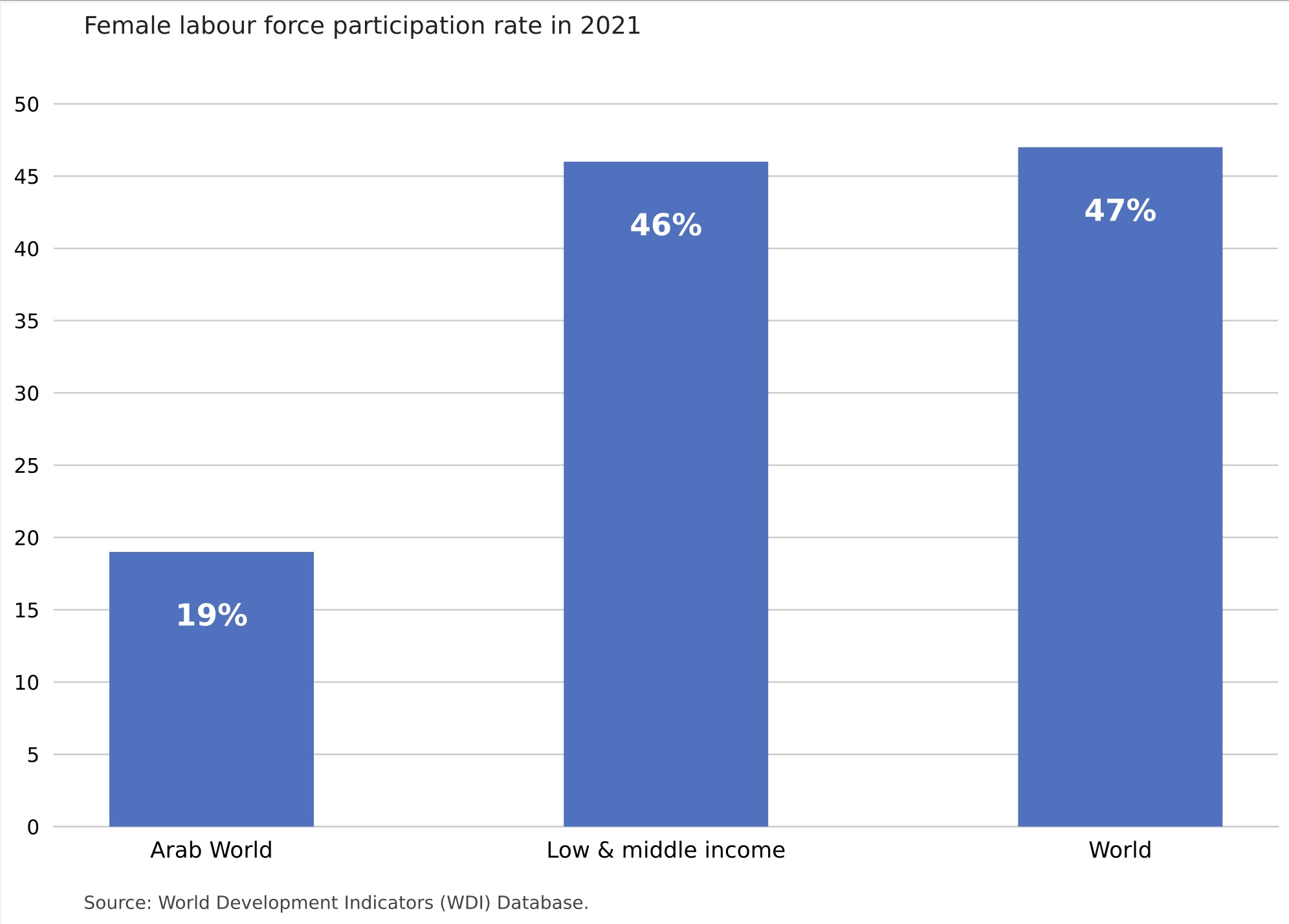
Nearly 80% of Arab women are outside the labour force entirely. The female unemployment rate is around 42%. These numbers underscore that only 1 in 5 Arab women are actively looking for jobs, and of those, only about half are able to find work.
The increase in educational attainment has simply not translated into workforce entry. The following question therefore arises: what are the real drivers behind low female labour force participation in the Arab region?
The Drivers
A study by the Arab NGO Network for Development (ANND) argues that unlike commonly thought, the reasons are more political-economy related than cultural or religous.
Economic need, or the lack thereof, holds greater influence on women's participation in the workforce than socio-cultural or religious factors do. The main drivers they highlight encompass:
Oil Revenues
High hydrocarbon-based revenues weaken the need for women to join the labour force. The ANND study finds that the ratio of women to men in the workforce is inversely related to oil sector growth: oil-rich countries like Saudi Arabia, Iraq, and Libya consistently register lower female participation, while states with little or no oil, such as Morocco, Tunisia, and Lebanon, show higher rates.
Oil wealth allows governments to redistribute income through public employment schemes, subsidies, and social programs, reinforcing the male-breadwinner family model and eliminating the economic need for a second household income. At the same time, the capital-intensive, male-dominated nature of the hydrocarbons sector suppresses demand for female labour.
The Public Sector
Women in the Arab region disproportionately prefer public sector jobs, which offer better compensation, maternity benefits, and safer working conditions. But waves of sharp reductions in government spending, often associated with IMF programs that aim to stabilize the economy, have sharply reduced public hiring. This is especially harmful when the economy's private sector is unattractive, discouraging women from joining the workforce.
In Egypt, for example, female labour force participation dropped from 23% in 2016 to 16% in 2019, coinciding directly with an IMF program that cut public spending. Without an attractive private sector alternative, women are pushed towards exiting the labor force entirely.
Legal Barriers
Discriminatory legal frameworks such as mobility, guardianship, property ownership, and the right to open a bank account or sign a contract, may discourage as structural disincentives to work.
IMF research identifies disparities in basic legal rights as the single most important determinant of low female participation in MENA, above cultural or attitudinal factors. Reforms are happening: Saudi Arabia, Kuwait, and Lebanon have all introduced changes in recent years, but implementation gaps remain wide.
Unpaid, Low-quality Care
One of the primary factors discouraging women in the Arab world from working is a lack of availability of affordable, high-quality childcare, in addition to rigid gender roles that pressure women to prioritize unpaid domestic labor.
A 2020 UN Women study links low female labour force participation directly to the highly unequal distribution of domestic care work across Arab states.
Without institutional support, the cost of working, especially for mothers with lower educational attainment or in the private sector, may outweigh the income it generates.
Safety and Transportation
Safety concerns, particularly regarding transportation and commuting, significantly limit women's mobility. Sexual harassment and workplace discrimination further discourage participation.
In the context of the Arab region, the World Bank suggests that conflict-affected countries, such as Yemen, Syria, Lebanon, and Iraq, result in instability which in turn creates severe barriers, including safety issues and limited access to decent jobs.
It's the Political Economy, Not the Culture
The trend of low female labour force participation in the Arab world is too often attributed to culture or religion. Research, however, consistently shows that religious women, when controlling for economic variables, do not participate in the labour market at lower rates than non-religious women.
What drives exclusion is not faith, but political economy factors in Arab countries, such as the shrinking of the public sector, discriminatory legal frameworks, unsafe country settings and transportation, and the absence of adequate care infrastructure.
Reform policies, from Saudi Arabia's Vision 2030 to Tunisia's constitutional guarantees, are important. But they are insufficient as long as the underlying political economy remains unchanged.