



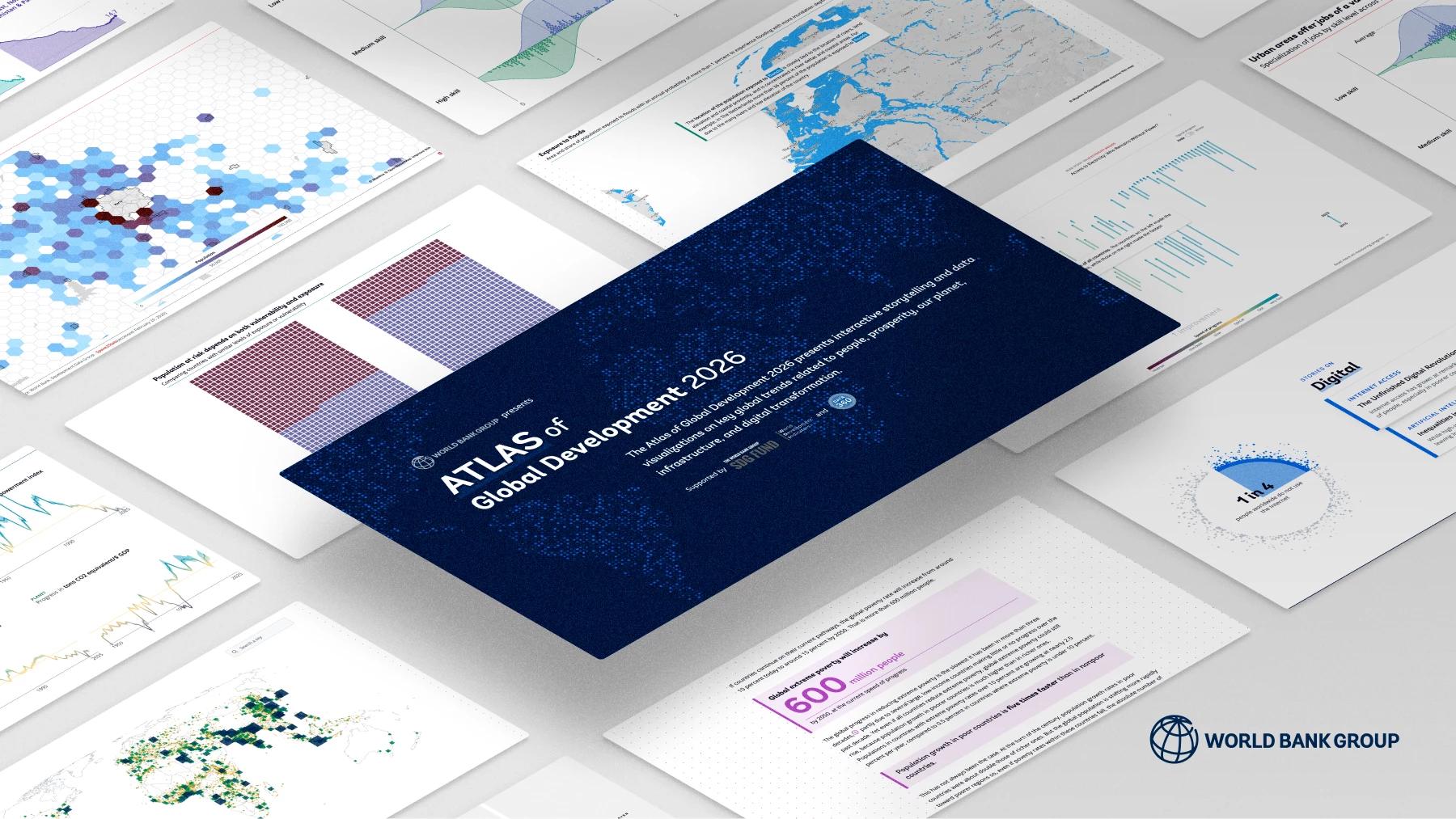
WORLD — The World Bank has released the Atlas of Global Development 2026, offering a comprehensive overview of global development trends through interactive data visualizations and storytelling.
The report highlights a concerning slowdown in development progress worldwide, while revealing widening inequalities across income, education, health, infrastructure, and digital access.
The latest edition introduces a new framework for measuring progress over the past 75 years, allowing countries to be assessed based on how quickly they have advanced from their own starting points across key development indicators.
Progress Slowing Across Multiple Indicators
According to the Atlas, progress is currently at its slowest pace on record for 15 of the 26 development indicators examined. The report warns that many gains achieved over recent decades are now facing significant challenges due to economic uncertainty, climate pressures, and persistent inequalities.
The publication also underscores the importance of reliable data, noting that many governments continue to make policy and budget decisions using outdated information, leaving millions of people effectively invisible in official statistics.
People: Employment and Skills Gaps Persist
The report finds that only one in two women worldwide participates in income-generating work, reflecting ongoing barriers to economic inclusion.
It also emphasizes the growing importance of workplace learning, noting that skills development continues well beyond formal education and plays a critical role in improving productivity and wages.
Prosperity: Poverty and Inequality Remain Major Challenges
Despite decades of poverty reduction, the Atlas reports that four out of five people globally live below the prosperity benchmark of $28 per day.
The report warns that shifting global conditions threaten progress against extreme poverty, while inequality continues to limit economic advancement in many regions. In Sub-Saharan Africa, for example, the prosperity gap remains comparable to global levels seen in the 1980s.
Planet: Water Quality and Climate Risks Intensify
Environmental challenges remain a major concern. Approximately half of the countries with available data face significant water quality issues, affecting public health and development outcomes.
Meanwhile, climate change continues to increase exposure to extreme weather events, with more than half of the world's population living in areas vulnerable to climate-related hazards.
Infrastructure: Urban Challenges Continue
The Atlas estimates that one in four urban residents globally lives in slum conditions, highlighting the need for improved urban planning and infrastructure investment.
While access to electricity has expanded significantly in recent decades, millions of people—particularly in rural parts of Sub-Saharan Africa—still lack reliable power.
Digital Divide Threatens AI Era Inclusion
The report also draws attention to growing disparities in digital development. Although internet access has expanded rapidly worldwide, many people remain excluded from the digital economy.
Perhaps most strikingly, the Atlas finds that only 5% of people in low-income countries possess the digital skills necessary to use artificial intelligence technologies, raising concerns that the benefits of the AI revolution may be concentrated in wealthier nations.
A Call for Data-Driven Development
Through its focus on people, prosperity, planet, infrastructure, and digital transformation, the Atlas of Global Development 2026 highlights both the achievements and setbacks shaping global development today.
The report concludes that stronger data systems, targeted investments, and inclusive policies will be essential to accelerate progress and ensure that development gains are shared more broadly across societies.