LEBANON - Lebanon’s education crisis did not begin with the latest escalation of conflict in March 2026. The war exposed and intensified weaknesses that had accumulated over more than six years, leaving children, teachers and schools struggling to recover from repeated disruptions.
A new report, “The Lost Generation: The Cost of War and Crises on Children’s Education in Lebanon,” by the Arab Center for Research and Policy Studies - Beirut, examines how years of economic crisis, political instability, school closures, teacher strikes and displacement have weakened Lebanon’s education system and how the latest war has deepened those challenges.
The report argues that the current crisis is not simply the result of the war. Rather, the conflict has compounded an education system that was already struggling to recover from years of disruption.
Lebanon’s education sector has been affected by the economic and financial collapse, the COVID-19 pandemic, the Beirut port explosion, repeated teacher strikes and instability, as well as the pressures associated with the displacement of Syrian children. These crises repeatedly interrupted schooling while reducing the ability of families, teachers and schools to absorb further shocks.
The result has been significant learning loss. According to the National Diagnostic Assessment conducted by Lebanon’s Ministry of Education and Higher Education and the Centre for Educational Research and Development for the 2024-2025 academic year, more than half of first-grade students lacked basic mathematics skills. By sixth grade, more than eight in 10 students had not mastered division.
The assessment also found that literacy levels could lag by as much as four and a half years by sixth grade. Children were therefore moving through the education system without acquiring skills expected for their age and grade.
How the War Deepened the Crisis
The renewed conflict did not create these learning gaps, but it made recovery considerably more difficult.
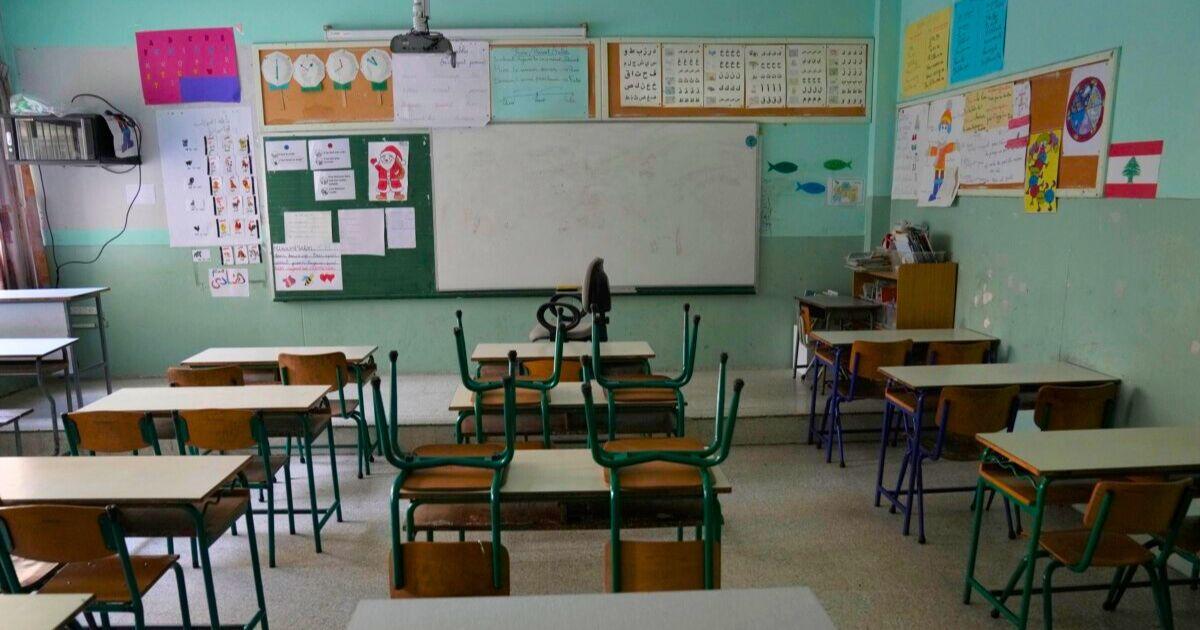
According to “The Lost Generation,” half of Lebanon’s public schools were used as shelters for displaced people at the height of the war. This disrupted the education of more than 250,000 students and removed a significant part of the public-school system from its primary role.
The consequences were particularly serious for children who depend most heavily on public education, including children from low-income households and displaced communities.
Emergency assessments cited in the report found that more than half of displaced children living in collective shelters were not enrolled in primary education. At the secondary level, six in 10 displaced adolescents were not attending school.
The shift to remote learning also faced major barriers. More than eight in 10 displaced families reported needing internet access and digital devices, making clear that online education could not automatically replace classroom learning.
The issue, therefore, was not simply school closures. For many children, there was no accessible alternative.
The Hidden Cost of School Closures
The report also highlights a dimension of the crisis that extends beyond academic performance: the loss of schools as spaces of protection and psychological support.
Schools provide children with routine, social interaction and contact with trusted adults. During conflict and displacement, these functions become particularly important.
National findings cited in “The Lost Generation” indicated that seven in 10 children showed symptoms associated with anxiety, while around six in 10 displayed symptoms associated with depression.
More than 40,000 children were also living in collective shelters covered by an emergency assessment, which identified mental health and psychosocial support as one of the major unmet needs.
When schools close, children can therefore lose several forms of support simultaneously. They lose learning time, daily structure and social interaction, while children already experiencing difficulties can fall even further behind.
An Implementation Problem
One of the report’s central arguments is that Lebanon did not lack evidence about the education crisis.
Before the war, national assessments had already documented serious weaknesses in literacy and numeracy. During the conflict, emergency assessments showed that large numbers of displaced children were disconnected from education.
Established approaches for maintaining learning during emergencies included temporary learning spaces, community-based education, accelerated learning programmes, printed materials, and blended learning.
Yet implementation frequently lagged behind the need.
Schools were rapidly converted into shelters because displaced families urgently needed protection. But educational alternatives were not always established with the same speed.
The report therefore characterises Lebanon’s experience not primarily as a crisis of knowledge or planning, but as a crisis of implementation and prioritisation.
Why the Learning Gap Matters
The consequences of learning loss extend far beyond the classroom.
Literacy and numeracy are foundations for future education. Children who struggle with reading and comprehension are more likely to face difficulties across other subjects, increasing the risk of disengagement and eventually dropping out.
The report warns that these gaps can also become an economic problem. Weak foundational skills limit children’s future educational and employment opportunities, potentially affecting Lebanon’s human capital for years to come.
This means that recovering lost learning is not simply about helping students catch up with a curriculum. It is about preventing temporary disruption from becoming a permanent disadvantage.
What Needs to Change?
“The Lost Generation” calls for education to become a core component of Lebanon’s emergency response from the earliest stages of a crisis.
The immediate priority should be foundational learning, particularly reading, writing and mathematics. Rather than focusing only on restoring the full curriculum, recovery efforts should first help children rebuild the skills they have missed.
Education should also be delivered wherever children are located. Temporary learning spaces, community-based programmes, blended approaches and other alternative arrangements can help maintain continuity when schools cannot operate.
The report further calls for stronger monitoring of attacks and damage affecting educational institutions, faster administrative procedures during emergencies and greater coordination between education and humanitarian actors.
Ultimately, the report places the best interests of the child at the centre of education policy during crises.
Lebanon’s challenge is therefore larger than reopening schools. The country must repair an education system weakened by years of disruption while helping children recover learning they have already lost.
The longer that recovery is delayed, the greater the risk that temporary educational disruption will become a lasting generational divide.