



MENA — Agriculture in the Middle East and North Africa is being reshaped by worsening food insecurity, water shortages, climate change and conflict, according to a new analysis by the Carboun Institute.
The analysis, published on May 18, examines agricultural trends across the region from 1960 to 2026 and highlights the growing gap between food demand and domestic production, alongside the environmental costs of current agricultural practices.
Agriculture remains an important part of the economy in non-GCC countries, employing around one-fifth of the workforce and contributing an average of 14% of GDP. In GCC countries, however, agriculture accounts for less than 1.5% of GDP.
Despite this economic role, all countries assessed are net food importers. Dependence on imports ranges from around 20% of domestic food supply in Egypt and Iran to more than 100% in some GCC countries, which rely on imports for over 90% of domestic consumption while also serving as major re-export hubs.
Growing Food Security Pressures
The analysis found that regional demand for agricultural products increased six-fold between 1960 and 2011, while agricultural production grew only fourfold, widening the gap between food demand and domestic supply.
By 2024, 40.2% of the region’s population was experiencing moderate or severe food insecurity, reflecting the combined impact of conflict, displacement, disrupted supply chains and increasing climate pressures.
Water scarcity is another major constraint. Agriculture accounts for an average of 67% of freshwater withdrawals across the countries assessed. When groundwater and surface water are considered separately, agriculture's share is commonly estimated at around 80–85%.
The analysis also estimates that regional water productivity is only around half the global average, while extensive water subsidies can mask the real costs of inefficient agricultural practices.
Climate and Land Degradation
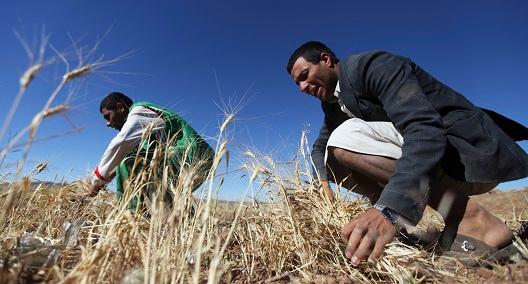
Climate change is expected to further intensify these pressures. Agricultural systems in the Maghreb are considered among the most vulnerable globally, with projections suggesting that around half of cultivable land could be lost by 2050.
Land degradation is already widespread. The Arab region has an average of 38% of its cropland degraded, compared with a global average of 31%.
In Egypt, Lebanon, Iraq, Yemen and Syria, 60% or more of cropland is reported to be degraded.
The economic consequences are also significant. The World Bank estimated that ecosystem-service losses linked to land degradation in MENA averaged around $5,600 per person and $300,000 per square kilometre in 2019, compared with global averages of approximately $1,000 per person and $50,000 per square kilometre.
Toward More Resilient Food Systems
The analysis argues that improving food security cannot rely solely on increasing domestic production or pursuing food self-sufficiency.
Instead, it calls for structural reforms in water governance, agricultural production, financing and food systems, alongside more diversified agricultural production, land restoration and more efficient infrastructure.
It also highlights the need to strengthen links between climate, nature and development finance to help agricultural systems adapt to a changing climate while reducing pressure on already depleted natural resources.