


BEIRUT – A university degree, a first job and financial independence are often seen as milestones towards a better future. Yet, young people across the Arab Mashreq do not start from equal positions. While some enter the job market with established networks and professional exposure, others must build these advantages while competing for the same opportunities. The difference lies not only in ability or ambition, but also in the circumstances and resources they inherit.
Dr. Dima Jamali, Dean of the Adnan Kassar School of Business at the Lebanese American University (LAU), argues that socioeconomic background shapes far more than an individual's financial resources. Family reputation, inherited wealth and social networks can influence access to education, employment and positions of influence. Equally important are the less visible advantages passed down through families.
“Privileged families often groom their children from an early age through elite education, international exposure, networking, and leadership, cultivating a sense of belonging and competence in influential circles,” she tells Enmaeya.
MARSAD and Addressing Data Poverty in the Region
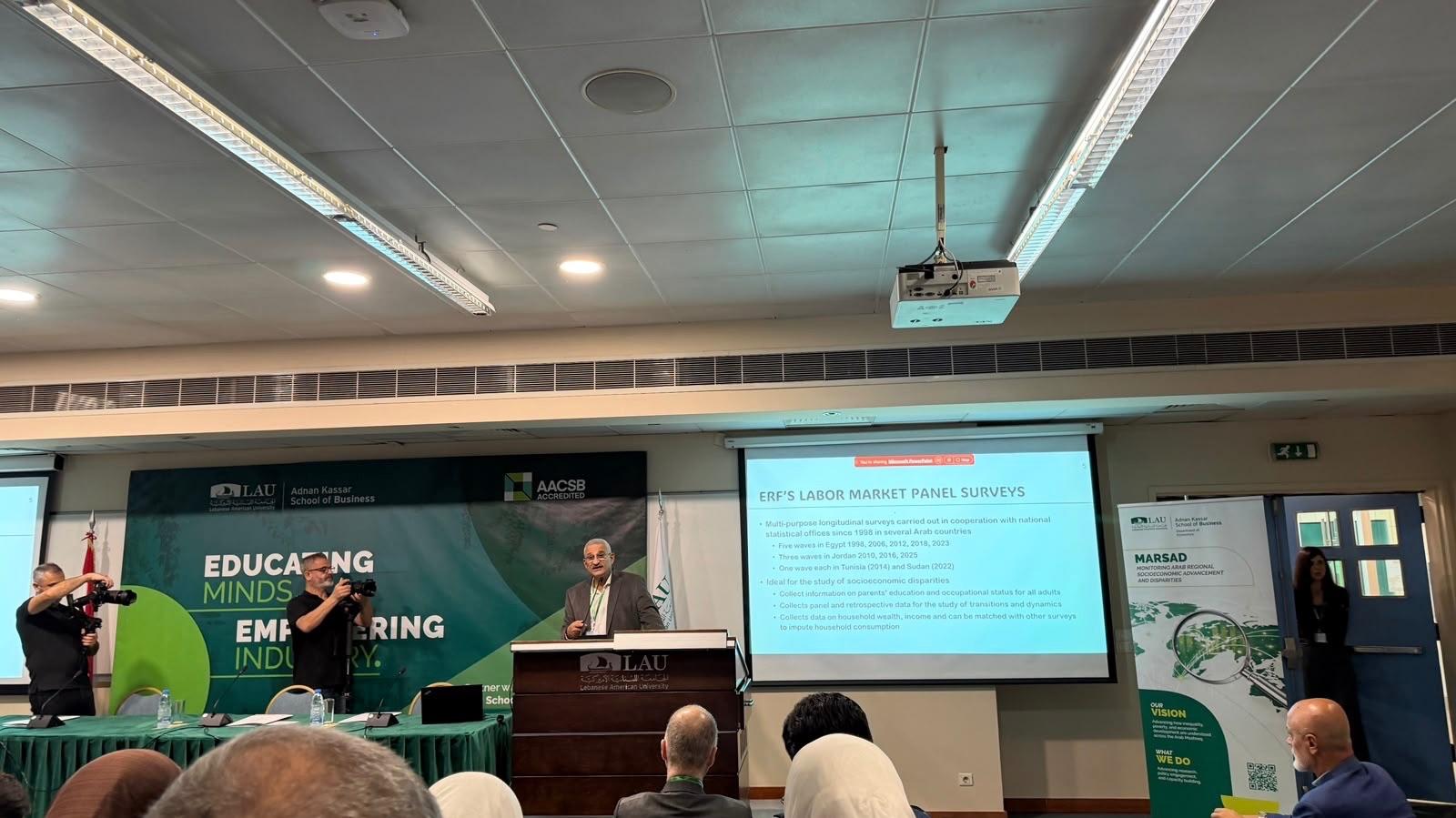
Dr. Jamali’s observations reflect some of the underpinnings behind MARSAD, the Monitoring Arab Regional Socioeconomic Advancement and Disparities observatory, launched at LAU on October 30, 2026.
The initiative aims to monitor poverty, inequality and socioeconomic development across the Arab Mashreq.
Its launch comes amid persistent data gaps across the region, with the Middle East & North Africa (MENA )region often described as a “data desert” (Ekhator-Mobayode and Hoogeveen, 2022). Microdata essential to studying socioeconomic disparities is frequently unavailable or inaccessible. MARSAD aims to help address this gap by strengthening the evidence base needed for research and policymaking across the Arab Mashreq.
Drawing on French sociologist Pierre Bourdieu's theory of cultural capital and habitus, Dr. Jamali explains that individuals inherit more than financial resources. They also acquire mindsets, aspirations, confidence, behaviors, and social codes that shape how they recognize and navigate opportunities.
These advantages can accumulate over time, widening the distance between those who inherit access and those who must first overcome additional barriers to reach comparable positions. For Dr. Jamali, this helps explain why two individuals with similar qualifications may not have the same opportunity to translate them into professional advancement.
Yet, she does not consider one's background an irreversible determinant of their future. “Background is a constraint, not a verdict,” she says, pointing to education, determination, mentorship and exposure as factors that can enable social mobility. However, moving beyond one's circumstances does not happen at the same pace or with the same degree of success for everyone.
Beyond the Degree
Education is widely regarded as one of the strongest pathways to social and economic mobility. But access to education alone does not guarantee better employment prospects or improved living conditions.
At the MARSAD launch, Dr. Ragui Assaad, Professor at the University of Minnesota, presented research showing that socioeconomic inequalities in Egypt and Jordan are particularly pronounced in access to private universities, followed by foreign-language and selective specializations within public universities. He noted that rising higher education enrolment has partly reflected a shift towards these institutions and programs, rather than a broad expansion of access across all educational pathways.
Lebanon reflects a similar divide in access to higher education. During the 2022–2023 academic year, around 70.4% of university students were enrolled in private institutions, compared with 29.5% at the Lebanese University, the country's only public university.
While comprehensive national data linking university enrolment to household income remain limited, research points to a socioeconomic divide between the two sectors. A 2025 academic study describes the Lebanese University as serving a greater proportion of students from lower socioeconomic backgrounds, while established private universities tend to attract more advantaged segments of society.
For Dr. Jamali, the question is whether academic learning is accompanied by the skills and resources needed to turn qualifications into opportunities. These include practical experience, communication skills, professional networks and familiarity with workplace expectations, which may be easier to acquire for those already exposed to such environments.
She argues that people from less privileged backgrounds can develop these competencies through continuous learning, exposure to different professional settings, and deliberate efforts to build new networks. However, this requires more than individual determination.
“Education translates into improved employment prospects and living conditions when academic learning is complemented by cultural capital, practical skills, meaningful networks, and the institutional support needed to turn potential into economic opportunity,” she says.
Dr. Jamali describes this as an intergenerational cycle in which some inherit opportunities while others must first overcome structural disadvantages before they can compete for them.
Measuring the Opportunity Gap
Understanding whether younger generations can move beyond their starting circumstances requires looking beyond economic growth and average income levels.
It also requires examining who benefits from economic progress, who has access to opportunities, and whether those opportunities become more equally distributed across generations.
Dr. Jamali sees MARSAD as an opportunity to turn inequality from a broadly recognized challenge into an evidence-based policy agenda. By examining disparities in access to education, employment and economic resources, the observatory can help identify structural barriers and assess how they affect different socioeconomic groups and generations.
Its role, she argues, should extend beyond collecting data to translating research into practical recommendations for governments, institutions and the private sector. She also points to MARSAD's Junior Fellows programme as a way to support emerging researchers and strengthen the region's research capacity.
Ultimately, the question is not simply whether individuals can succeed despite the circumstances into which they are born. It is whether the conditions that shape their opportunities can change, so that a person's future depends less on inherited advantage and more on their abilities and efforts.


