






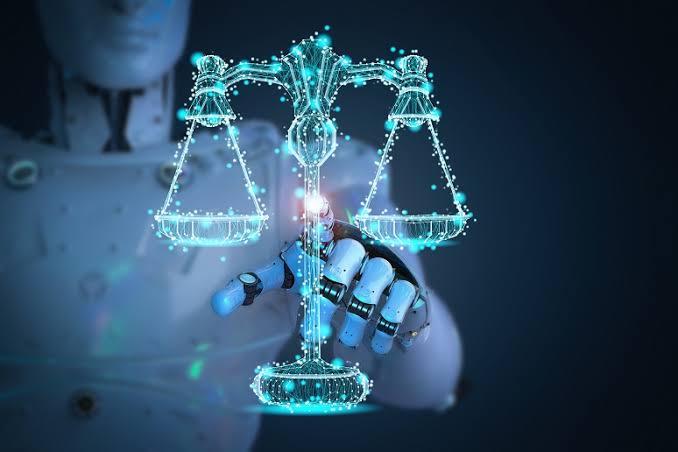
As I sat on the chair, wondering how I could write an article that would captivate the reader and make them soar through a world of imagination, wandering through layers of magic, I found myself unable to write. Every time my fingers held the pen, I hesitated, stopped, and became unable to think or write. A flood of conflicting emotions swept through me. My thoughts scattered, my words fell apart between the lines, and my phrases drifted like autumn leaves, until I returned once again to the starting point.
Then I realized the reason. I understood that the feelings of misery, laziness, and hesitation overwhelming me were not due to a lack of innovation or creativity, but rather to the constant thought that artificial intelligence has the ability to write what I cannot. This is what hinders my progress and creativity, restricts my ability to dive into my feelings and creative thoughts, and leaves me unable to embody my imagination and innovation.
Yet we are the ones who allowed this intelligence to flourish and develop. In a world where algorithms move faster than our steps inside classrooms, the most urgent question becomes: are we creating educated students, or consumers of information? Truthfully, technology teaches us faster and in better ways, but it cannot create critical thinking, glowing inspiration, refined excellence, or renewed creativity. The question that always comes to my mind is this: can algorithms create an educated human being, or is the role of the human being truly irreplaceable?
Artificial intelligence is a branch of computer science that aims to develop computer systems capable of simulating certain functions of the human mind, such as analysis, learning, and linguistic interaction, without necessarily contributing to the development of these abilities in human beings. As stated in Our Children and Imagination by the writer Sultan Nasser El-Dine, through perception we receive information, and through imagination we transform these perceptions into mental images. Through imagination, we fly and soar; through imagination, we search for everything new. Imagination is the dream that rises freely without limits, and the hope that breaks through the sky as though released from chains.
Artificial intelligence emerged in the 1950s and officially gained prominence in 1959 at the Dartmouth Workshop. It later developed in the 1970s as a specialized field, particularly in education, with the use of computers to enhance teaching effectiveness, before expanding further during the technological revolution.
Many books have addressed the concept of artificial intelligence and ways to benefit from it. Among the most notable is Life by Max Tegmark, which explains the role of human beings in the age of artificial intelligence, as well as Artificial Intelligence by Russell and Norvig, which explores the development of the field and its applications, such as machine translation and household robots.
Algorithms are no longer merely digital tools. They have become “hidden minds” that observe the learner, contributing to faster access to knowledge beyond the limits of time and place.
However, they have not been able to develop innovation in rising minds. We must imagine, because imagination is the ability to set ideas free. It liberates us from the prison whose fence is built by algorithms and whose walls are formed by artificial intelligence. As mentioned in Our Children and Responsibility by Dr. Sultan Nasser El-Dine, freedom and responsibility are like conjoined twins; if one is separated from the other, both die.
Speaking about artificial intelligence is not a linguistic luxury or a mere accumulation of words. It is a deep dive into meaning and a serious attempt to understand a reality that shaped the features of the past, continues to draw the contours of the present, and influences the future. Artificial intelligence is a double-edged sword.
In a time when the clashing of swords was once a symbol of power, education now has a new sound: the pulse of artificial intelligence. It opens horizons for learning, simplifies complex concepts, and ignites student engagement by adding a spirit of enthusiasm and an atmosphere of activity. As for the teacher, artificial intelligence has become a supportive partner, not a replacement. It helps teachers analyze students’ performance, suggest educational strategies, and provide more time for guidance, motivation, and the building of the human dimension in education.
Nevertheless, every sword has two edges. Just as the sound of swords in the past carried both victory and danger, artificial intelligence carries both opposites at once.
Excessive use of it leads to intellectual laziness and kills innovation. It stands as a barrier before the human mind, preventing it from engineering the ideas that shine within it. It also obstructs the thinking skills of some students, as they tend to receive answers instead of embarking on the journey of understanding and research. Another risk is the transmission of inaccurate information, since artificial intelligence tools are not immune to error and require the skill of verification and review.
In this context, the role of the human being emerges in addressing the major challenge: balancing students’ use of artificial intelligence. Students today are in a stage of discovering this universe, where ideas have crowded together and voices have intertwined. Artificial intelligence stands as a central issue that imposes its presence on the mind before the pen. This generation is influenced by the events it experiences and the eras that pass over it. Every step, every idea, and every question opens new doors to knowledge that they are capable of discovering.
As Dr. Ahmad Shaalan wrote in his book A Universe Difficult to Understand, previous history is evidence of the human ability to generate, discover, and create. So why do we believe in our past but not bet on a scientific future?
In conclusion, artificial intelligence remains a vast force that cannot be fully seen, a wide world whose ideas cannot be counted, and another age that draws us into it so that we may become creatures who know nothing but algorithms. It is that infinite space where the stars of the future shine, and a vast universe that can contain the galaxies of the world and everything within them.
Since the dawn of existence, human beings have contemplated this eternal world. But has the thought settled in their minds, appeared in their imagination, and flowed through their consciousness: to what extent can artificial intelligence affect students’ intellectual abilities and skills?
Mohamad Koteich