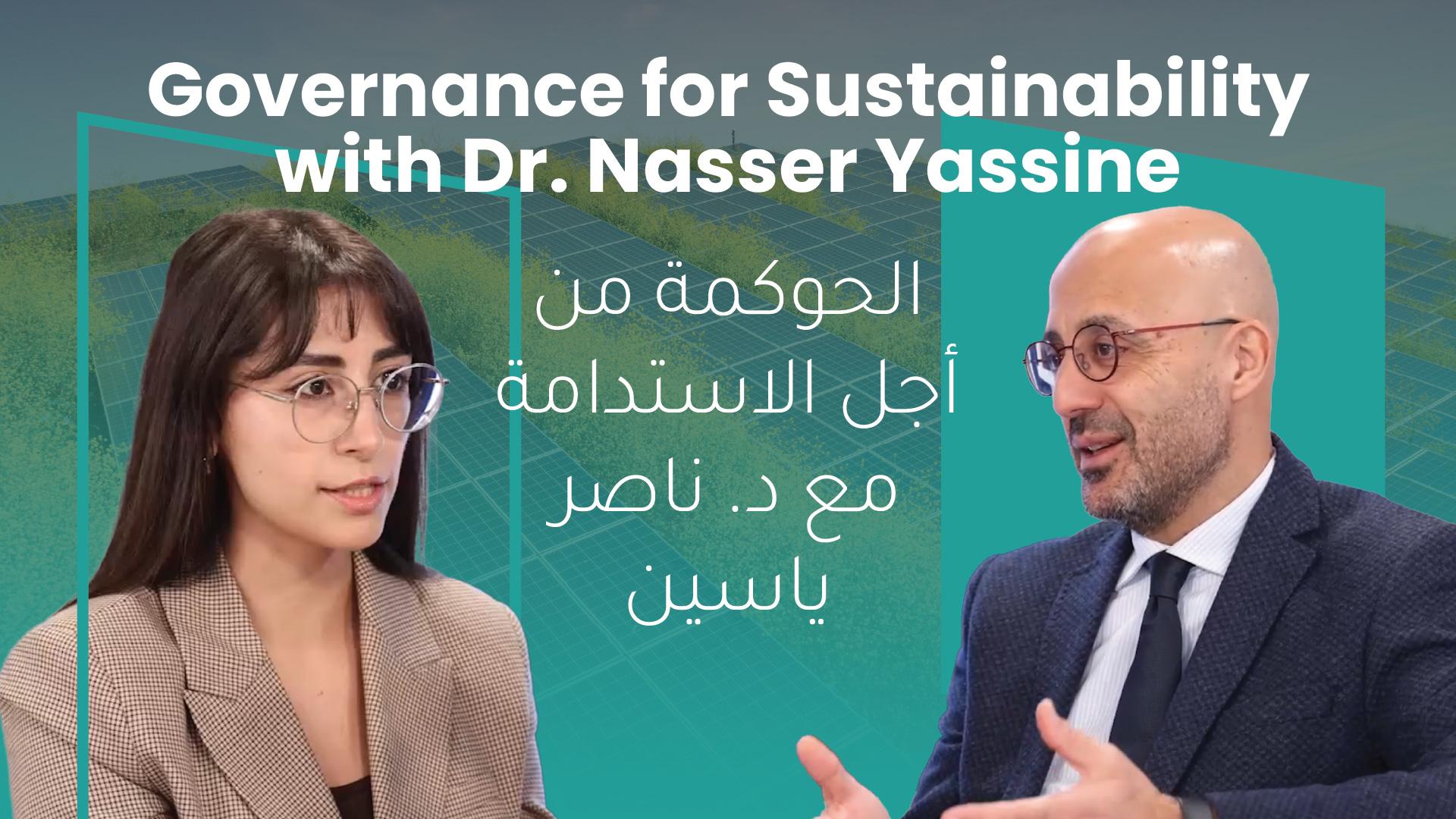
Sustainability in Lebanon is no longer only an environmental question, it is fundamentally a governance question.
In this episode of Governance for Sustainability, Dr. Nasser Yassine, Former Minister of Environment and Director of the Arab Center for Research and Policy Studies – Beirut, reflects on the institutional foundations required to move sustainability from rhetoric to reality. Drawing on his experience in public office and academia, he argues that environmental challenges, including water scarcity, waste management crises, climate vulnerability, and post-conflict ecological damage, cannot be addressed through technical solutions alone. They demand accountable institutions, coordinated policymaking, and long-term strategic continuity beyond political cycles.
The discussion examines Lebanon’s recent strategic frameworks, including the National Adaptation Plan and long-term climate strategies, highlighting the governance conditions necessary to ensure implementation rather than stagnation. The episode explores institutional data capacity, cross-ministerial coordination, evidence-based decision-making, and the concept of ecological citizenship, positioning sustainability as a shared responsibility between state and society.
At a moment marked by economic hardship, environmental degradation, and reconstruction efforts, this conversation reframes sustainability not as an abstract ideal or secondary priority, but as a structural pillar for resilience, public trust, and intergenerational equity.