


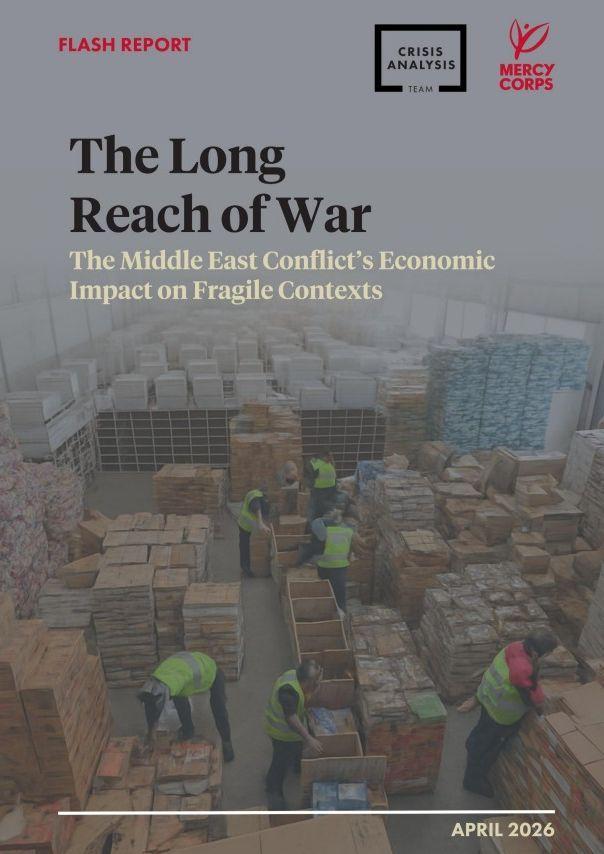

The Long Reach of War: The Middle East Conflict’s Economic Impact on Fragile Contexts was published in April 2026 by Mercy Corps’ Crisis Analysis Team. The flash report examines how the Middle East conflict and the effective closure of the Strait of Hormuz have transmitted economic shocks far beyond the immediate war zone, affecting fragile countries that are already facing humanitarian stress. It focuses on Somalia, Sudan, Pakistan, Ethiopia, and Myanmar, and explains how disruptions in fuel, fertilizer, and shipping are worsening livelihoods, agricultural production, and food security.
Key insights:
The report finds that the conflict has triggered major global market disruptions, with Brent crude rising around 78%, global urea prices increasing about 68%, and commercial transits through the Strait of Hormuz dropping by roughly 94% during the war period.
It argues that even after the announced ceasefire, the shock has not been reversed, because the Strait of Hormuz did not return to normal commercial operation, and shipping restrictions, insurance costs, and delays continue to affect supply chains.
The report warns that a critical agricultural threshold was already crossed: according to the FAO Chief Economist cited in the paper, disruption lasting more than 40 days can change farmer behavior through reduced fertilizer use, crop switching, and smaller planted areas, with consequences likely to affect the 2026 and 2027 harvests.
In the five case countries, the shock is transmitted through different channels: Somalia faces immediate fuel and food price increases in a highly import-dependent economy; Sudan sees humanitarian shipments rerouted with longer delays and higher costs; Pakistan faces fertilizer pressure during a key planting window; Ethiopia has moved from price stress to actual fuel shortages and rationing; and Myanmar is seeing diesel and irrigation costs rise sharply, hurting domestic production.
The report highlights that fragile contexts are absorbing these shocks while already severely underfunded. Across the countries reviewed, millions are already in humanitarian need, and funding gaps remain severe, leaving populations with very limited ability to absorb further price increases or supply disruptions.
Mercy Corps emphasizes that the consequences are not only economic but also humanitarian: rising fuel and fertilizer prices are expected to translate into higher food prices, weaker harvests, and greater acute hunger, with the report citing estimates that an additional 45 million people globally could be pushed into acute hunger