


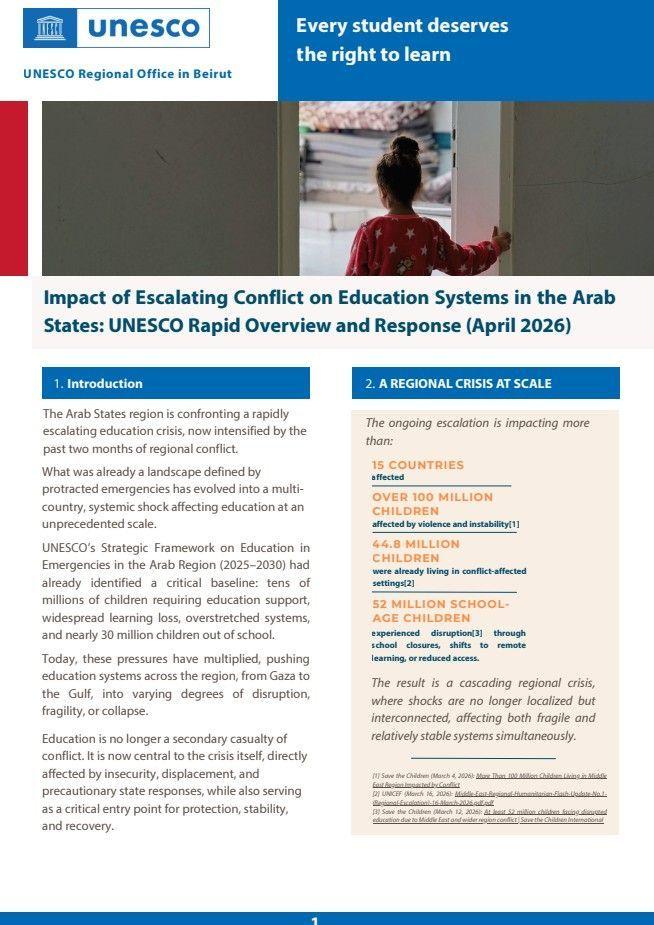

The UNESCO report warns that the escalating conflict in the Arab States has become a regional education emergency, affecting both fragile and relatively stable countries. More than 100 million children are impacted by violence and instability, while 52 million school-age children have experienced disruption through school closures, remote learning, or reduced access to education.
The report highlights that education systems are being strained in several ways: schools are damaged or used as shelters, learning is shifting to emergency or online formats, students and teachers are facing severe psychological stress, and education institutions are struggling financially and operationally.
Lebanon is presented as a clear example of this pressure, with 1,156 public schools designated as shelter centers and 570 schools closed or located in conflict areas, affecting 241,671 students. In Gaza, the situation is described as near-collapse, with 97.5% of schools damaged or destroyed, over 637,000 children out of school, and more than 1 million children needing psychosocial support.
The crisis is also affecting higher education, especially in Gaza, Lebanon, Syria, Iraq, and the Gulf. Universities are facing damage, closures, remote learning shifts, faculty displacement, delayed graduations, and weakened research and employment pathways.
UNESCO’s response focuses on keeping learning going while strengthening long-term resilience. This includes temporary learning spaces, digital and blended learning, mental health and psychosocial support, teacher training, social and emotional learning, and support for higher education continuity.
Overall, the report concludes that the region faces a serious risk of long-term learning loss, rising dropout, widening inequality, and irreversible human capital loss unless education receives urgent, coordinated, and sustained support.