


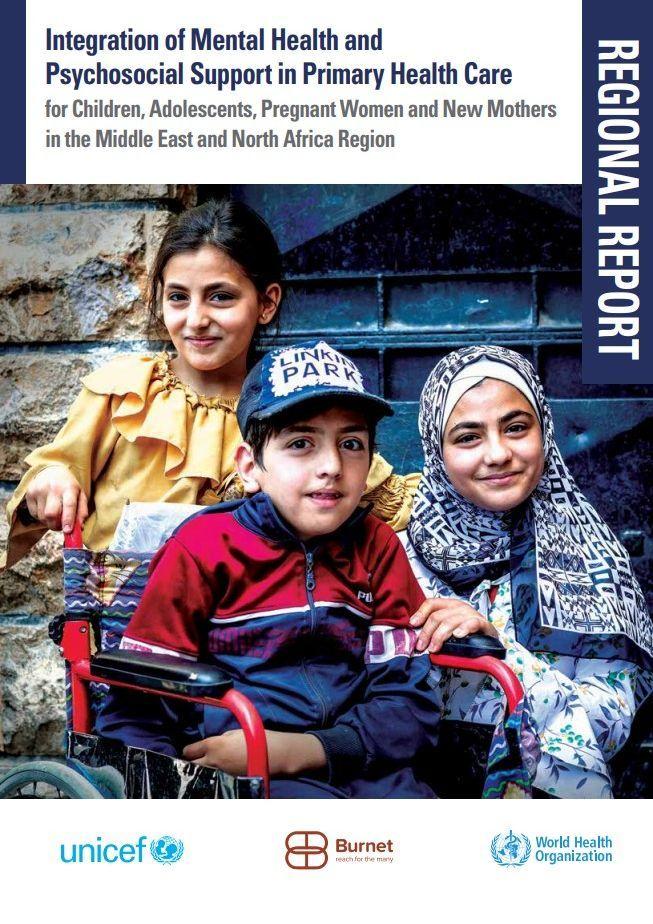

This UNICEF MENARO, Burnet Institute, and WHO EMRO regional report examines how Mental Health and Psychosocial Support (MHPSS) can be more effectively integrated into primary health care systems for children, adolescents, pregnant women, and new mothers across the Middle East and North Africa region. The report highlights a major and growing mental health burden: around one in six adolescents aged 10–19 in the region are estimated to be living with a mental disorder, while suicide remains a leading cause of death among older adolescents. It also underlines the significant mental health risks faced by children and young people, including exposure to violence, bullying, displacement, poverty, child labour, conflict, and family stress. Maternal mental health is also identified as a critical concern, with postpartum depression affecting a substantial proportion of women in the region.
A central finding of the report is that, although mental health has gained greater policy attention in recent years, especially after COVID-19, this has not yet translated into sufficient investment, implementation, or service integration at the primary health care level. Services remain largely concentrated in specialized or hospital-based settings, with limited availability of child-, adolescent-, and maternal-focused care within community and primary care platforms. The report also identifies major gaps in early identification, screening, referral systems, workforce capacity, data collection, community engagement, and coordination between health, education, child protection, and social welfare sectors.
The report recommends a stronger national commitment to child, adolescent, and maternal mental health, supported by clear policies, dedicated funding, and measurable targets. It calls for integrating MHPSS into existing primary health care entry points such as antenatal and postnatal care, vaccination services, well-baby clinics, adolescent health services, and chronic illness care. It also emphasizes the need to train and support primary health care workers, strengthen referral pathways, expand prevention and promotion activities such as parenting programmes and anti-stigma campaigns, and meaningfully engage children, adolescents, families, and communities in service design and evaluation. Overall, the report presents primary health care as a critical pathway for making mental health support more accessible, less stigmatized, and better connected to the everyday needs of children, families, and communities across the MENA region.