


Enmaeya LogoEnmaeya Logo
Home
News
Opinion
Hub
Calendar
Studio
Chat Room
Search
Login
Login
Burger Logo
enmaeya
Search
Home
News
Opinion
Calendar
Studio
Hub
Chat Room
About Us
Enmaeya team
Privacy Policy
Terms and Conditions
Social Media
Contact Us
tel:+96103258219
+961 03 258 219
mailto:info@enmaeya.com
[email protected]
mailto:support@enmaeya.com
[email protected]
Overview
Events
Resources
Partners in development
Logo
footerLogo
Subscribe to our newsletter
Quick Links
Home
News
Opinion
Chat Room
Enmaeya hub
Overview
Events
Resources
Partners in development
Enmaeya Studio
Studio
Interviews
Podcast
Programs
By Partners in development
Get to know us
About Us
Enmaeya team
Privacy Policy
Terms and Conditions
© 2024 Enmaeya, LLC. All Rights Reserved. Use of this site constitutes acceptance of our Terms of Service, Privacy Policy and Do Not Sell or Share My Personal Information. Indie Space may receive compensation for some links to products and services on this website. Offers may be subject to change without notice.
 Screenshot 2026-06-01 11075
Home
Hub
Resources
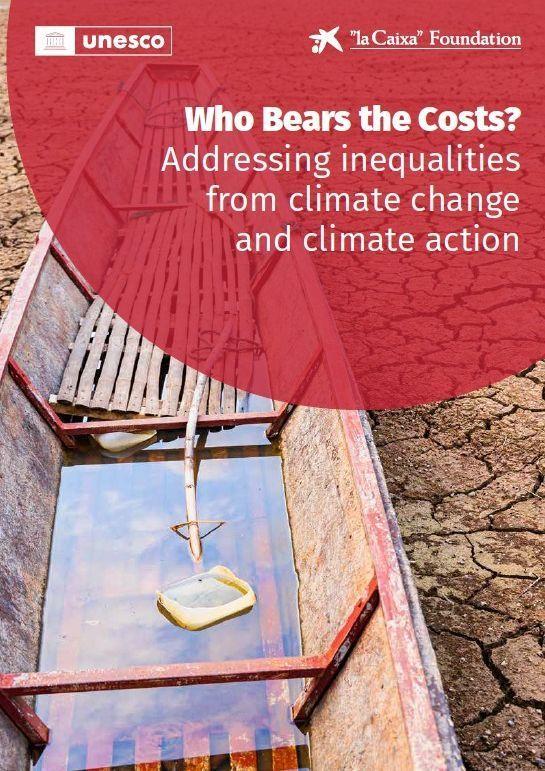
Who Bears the Costs? Addressing Inequalities from Climate Change and Climate Action
 Screenshot 2026-06-01 11075
Environment
Who Bears the Costs? Addressing Inequalities from Climate Change and Climate Action
avatar
United Nations Educational, Scientific and Cultural Organization (UNESCO)
Share
Home
Hub
Resources
Who Bears the Costs? Addressing Inequalities from Climate Change and Climate Action
Description
United Nations Educational, Scientific and Cultural Organization (UNESCO) |Dec. 2, 2024

The Who Bears the Costs? Addressing Inequalities from Climate Change and Climate Action report was published by UNESCO and “la Caixa” Foundation on 11 December 2025, with a last update on 4 March 2026. The report examines how climate change does not affect everyone equally, and how climate policies can also create new inequalities if they are not designed fairly. It focuses on the need for climate action that protects vulnerable groups, supports the Global South, and ensures that the costs of transition are not carried by those least responsible for the crisis.

Key insights:

  • Climate change deepens existing social and economic inequalities, especially for poorer communities, workers in vulnerable sectors, women, youth, Indigenous peoples, and communities in the Global South.

  • The report argues that climate action must be designed with fairness at its core, because poorly planned green transitions can shift costs onto low-income households and workers.

  • It highlights the importance of asking who pays, who benefits, and who is protected when climate policies are introduced.

  • Climate finance is a central concern. The report calls for a major increase in climate financing, including a target of USD 1.3 trillion annually by 2035, with priority for the Global South.

  • The report stresses that mitigation and adaptation policies should be linked to social protection, decent work, education, and inclusive public participation.

  • It warns that climate policies that ignore inequality may face public resistance and risk slowing down climate action.

  • A just climate transition requires targeted support for affected workers, communities, and sectors, especially where livelihoods depend on fossil fuels, agriculture, or climate-sensitive job


Related Events
GLF Climate 2025
avatar
N/A
Oct. 17, 2025|Online
More like this
Resource
Lebanon Climate Snapshot 2025
Environment
avatar
World Food Programme
Feb. 5, 2026
Main Topics
Climate Change
Topics
Climate Adaptation & Resilience
Climate Action