
The MHPSS Emergency Response Update presents Lebanon’s mental health emergency response as active, coordinated, and multi-layered. Led by the National Mental Health Programme, and co-chaired by WHO and UNICEF, the response brings together national actors, ministries, UN agencies, NGOs, and frontline professionals to maintain mental health and psychosocial support during the emergency period.
The update highlights continued work across several levels of care, including awareness raising, shelter outreach, community and family support, focused psychosocial support, specialized consultations, inpatient care, mobile crisis response, and access to psychotropic medication. It also shows that digital and remote services, such as the National Lifeline, Step-by-Step, and Self-Help Plus, remain important tools for expanding access to support.
At the operational level, the report points to stronger coordination through national and sub-national mechanisms, including meetings in Bekaa, South, and North, as well as ongoing efforts to mainstream MHPSS indicators into national reporting systems. However, it also highlights continuing challenges, including the evacuation of mental health facilities in high-risk areas, disruption in continuity of care, and the need to sustain medication access, referral pathways, and frontline worker support.
Key numbers from the update include:
More than 100 partner actors involved in the MHPSS emergency response.
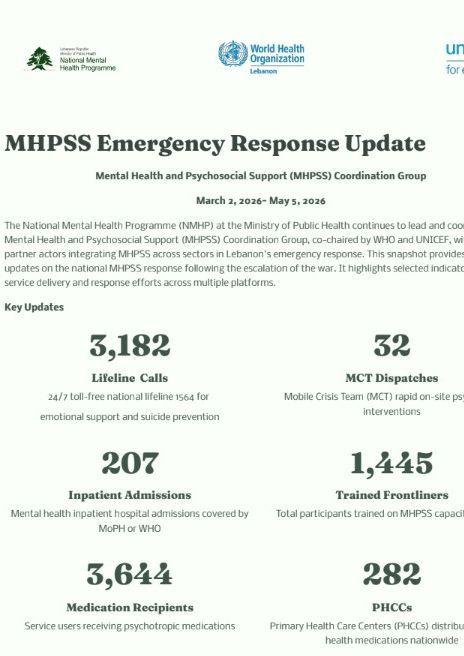
3,182 calls received by the national Lifeline 1564.
32 Mobile Crisis Team dispatches.
207 inpatient mental health admissions covered by MoPH or WHO.
1,445 frontline workers and partners trained or oriented.
3,644 service users receiving psychotropic medications.
282 centers distributing mental health medications nationwide.
81 PHCCs operating with psychiatrists.
Nine hospitals providing full MoPH coverage for psychiatric hospitalization.
Overall, the update shows that Lebanon’s MHPSS response has remained functional and adaptive under emergency conditions, but continued investment is needed to strengthen coordination, service continuity, community-based support, medication systems, and data reporting.