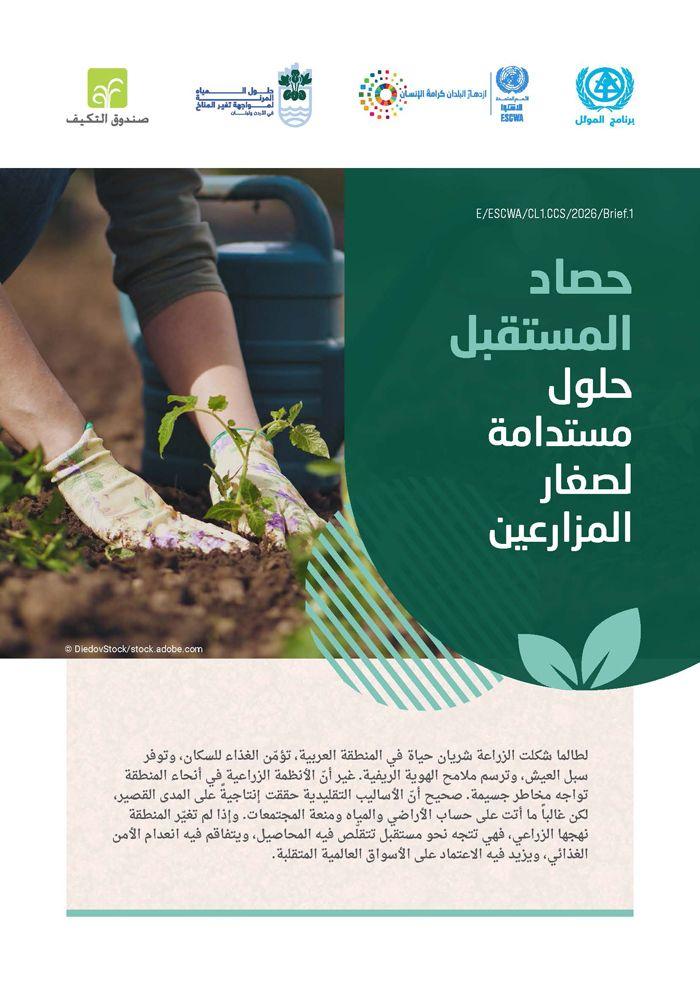

Harvesting the Future: Sustainable Solutions for Small Farmers is a brief / practical guidance note published by ESCWA as part of the Climate-Resilient Water Solutions in Jordan and Lebanon project, led by UN-Habitat in collaboration with ESCWA, and funded by the Adaptation Fund. It focuses on sustainable agriculture practices for small farmers in the Arab region, especially in contexts affected by water scarcity, climate change, land degradation, and rising food insecurity.
Key insights:
The brief presents agriculture as a lifeline in the Arab region, providing food, livelihoods, and rural identity. However, it warns that current agricultural systems face serious risks because many conventional practices prioritize short-term productivity while degrading land, water, and community resilience.
It explains that unsustainable farming practices are widespread across the region and are further intensified by structural pressures such as water scarcity, climate change, weak regulation, conflicts, and economic vulnerability.
One major challenge is the excessive use of water for irrigation. Many farmers rely on inefficient irrigation methods and over-extract groundwater, which contributes to soil salinization, falling groundwater levels, and declining soil fertility.
Another challenge is overreliance on chemical fertilizers and pesticides. The brief notes that weak regulatory systems and limited enforcement in many Arab countries allow hazardous chemicals to be used in uncontrolled ways, increasing soil, air, and water pollution and creating health risks.
Monocropping is also identified as a problem. The repeated cultivation of one crop, such as wheat or commercial vegetables, can deplete soil nutrients, increase vulnerability to pests and climate shocks, reduce biodiversity, and weaken the resilience of farming systems.
The brief also highlights land degradation and desertification, driven by overgrazing, deforestation, and poor soil management, especially in North Africa and the Arabian Peninsula.
Energy-intensive mechanization and protected agriculture, such as plastic greenhouses, can increase greenhouse gas emissions and operating costs when they depend heavily on fossil fuels.
Poor agricultural waste management is another concern. Crop residues, plastic covers, and animal waste are often burned or discarded, causing pollution and wasting opportunities to improve soil fertility or generate renewable energy.
The brief defines sustainable agriculture as farming that produces enough food for current needs while protecting land, water, and communities so that farming can continue for future generations.
Sustainable agriculture is based on careful use of resources, protection of soil, water, and land, reduction of pollution and waste, and support for resilient and sustainable rural economies.
The brief argues that small farmers are central to this transition. They contribute more than 80% of agricultural production in the Near East and North Africa and manage 75% to 85% of agricultural land in many Arab countries.
Small farmers also play a central role in food security, nutrition, and rural livelihoods. Any decline in their productivity or resilience can threaten national food systems.
The brief explains that sustainable farming can benefit small farmers economically by reducing costs through better water efficiency, lower spending on fertilizers and pesticides, natural pest control, diversified crops, energy savings, and improved access to markets for organic and environmentally friendly products.
It also highlights health benefits, including safer food, lower exposure to toxic pesticides for farmers and workers, reduced food-related health risks, and cleaner air, water, and soil.
Social benefits include creating rural jobs in composting, irrigation system maintenance, and local food processing, increasing youth employment in agriculture, strengthening cooperatives, improving farmers’ bargaining power, and supporting food security through diverse locally available foods.
Environmental benefits include conserving scarce water resources, restoring soil fertility, reducing pollution from synthetic fertilizers and pesticides, protecting biodiversity, and supporting safer ecosystems.
The brief proposes practical steps for small farmers. These include using water carefully by irrigating early in the morning or evening, adopting drip irrigation, collecting rainwater in tanks, reusing water where safe and locally permitted, and avoiding unnecessary flooding of fields.
It recommends maintaining healthy soil by using compost or animal manure, diversifying crops through rotation, and planting cover crops to protect and enrich the soil.
The brief encourages natural pest control by planting different crops side by side, using companion planting, and planting flowering strips to attract birds and beneficial insects.
It also recommends planting local and climate-adapted crops, such as date palms, olives, desert herbs, and drought-resistant crops like sesame, while choosing flood-tolerant crops in wetter or flood-prone areas.
To reduce energy use and costs, the brief suggests using gravity-fed irrigation where possible, solar-powered irrigation pumps, and reducing repeated ploughing to save fuel, lower labour costs, and protect soil structure.
The brief also points farmers to freely available online resources, including sustainable agriculture guides from the Agricultural Movement in Lebanon, ESCWA, Terab for Environmental Education Lebanon, and Mercy Corps.
Main message: Sustainable agriculture is not only an environmental choice; it is a practical pathway for protecting small farmers’ livelihoods, improving food security, reducing costs, conserving scarce water, restoring soil health, and building rural resilience. Small, steady changes in water use, soil care, pest management, crop selection, and energy efficiency can help farmers in the Arab region produce healthier and more reliable harvests while protecting land and communities for the future.