



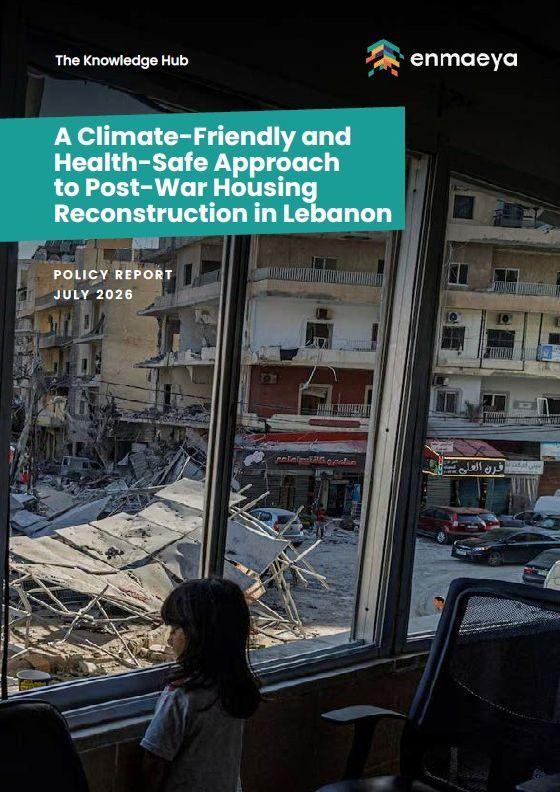

Post-war housing damage, unmanaged debris, rising energy costs, extreme heat, water stress, and fragmented building standards, individually and collectively, pose critical challenges to Lebanon’s recovery. As reconstruction moves forward, the way homes are repaired or rebuilt will shape not only safe return, but also household affordability, health, energy use, water demand, and resilience to future climate pressures.
Rebuilding Right: Climate and Health-Smart Housing Reconstruction in Lebanon examines how Lebanon can move beyond replacing damaged homes toward reconstruction that is safer, cooler, healthier, and cheaper to run. The policy brief brings together evidence on housing damage across South Lebanon, Beirut, Mount Lebanon, and Baalbek-Hermel; the risks linked to rubble and hazardous debris; and practical measures such as passive cooling, low-emission materials, water-smart design, green infrastructure, solar readiness, and hazard-aware structural repair.
Developed by Enmaeya’s Knowledge Hub, the brief highlights that Lebanon’s challenge is not the absence of technical solutions, but the lack of a unified standard, clear enforcement trigger, managed debris pathway, and financing mechanisms that make better reconstruction accessible to vulnerable households. It concludes with policy options and a sample Climate and Health Reconstruction Checklist to help translate climate, health, safety, and affordability priorities into practical steps for each repaired or rebuilt home.