






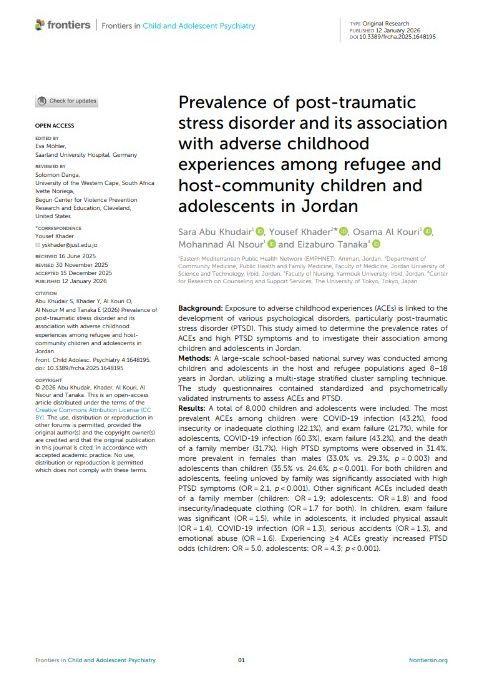

The Frontiers in Child and Adolescent Psychiatry original research article Prevalence of Post-Traumatic Stress Disorder and Its Association with Adverse Childhood Experiences Among Refugee and Host-Community Children and Adolescents in Jordan examines the relationship between adverse childhood experiences (ACEs) and PTSD symptoms among young people in Jordan. Published on 12 January 2026, the study used a national school-based survey of 8,000 children and adolescents aged 8–18 from Jordanian, Syrian and Palestinian refugee and host-community populations. It focuses on the prevalence of ACEs, PTSD symptoms, differences by age and gender, and the cumulative effect of multiple adverse experiences.
Key Insights
About 31.4% of participants showed high PTSD symptoms. Figure 1 on page 5 shows higher rates among adolescents than children, at 35.5% versus 24.6%, and higher overall rates among females than males.
Table 1 on page 4 shows that the most common ACE was COVID-19 infection affecting the child or a family member: 43.2% among children and 60.3% among adolescents. Exam failure and sudden family death were also common.
Adolescents generally reported more ACEs than younger children. Among children, food insecurity or inadequate clothing affected 22.1%, while among adolescents exam failure affected 43.2% and sudden family death 31.7%.
Feeling unloved by one’s family showed the strongest association with high PTSD symptoms in both age groups, with odds about twice as high (OR = 2.1), according to Table 3 on page 8.
Sudden family death and food insecurity were also strongly associated with PTSD. Exam failure was significant among children, while physical assault, emotional abuse, COVID-19 infection and serious accidents were significant among adolescents.
The cumulative effect of ACEs was substantial. Table 4 on page 9 shows that experiencing four or more ACEs increased the odds of high PTSD symptoms fivefold among children and 4.3-fold among adolescents.
Nationality differences were more evident among younger children. Syrian children living outside camps had the highest PTSD prevalence at 30.2%, while no statistically significant nationality differences were found among adolescents.
The study recommends comprehensive interventions involving families, schools, communities and social services. School-based programmes are highlighted as particularly suitable in Jordan, alongside stronger mental health and social welfare support.
The authors note that the cross-sectional design cannot establish causality and that sensitive experiences may have been underreported. No major internal numerical or chronological inconsistency is apparent in the article.