






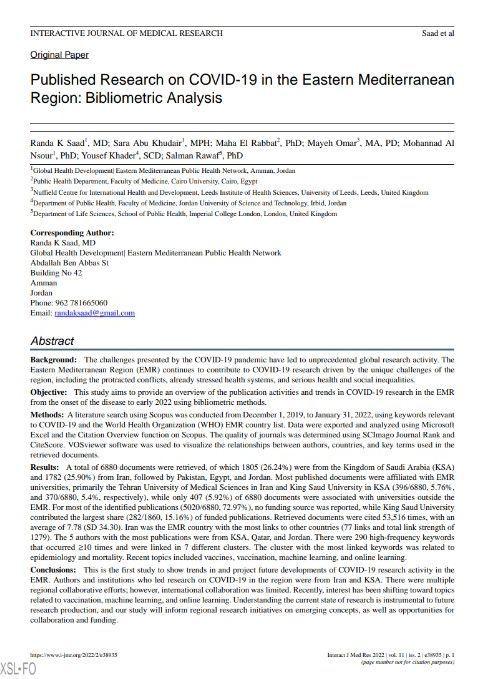

The Interactive Journal of Medical Research article Published Research on COVID-19 in the Eastern Mediterranean Region: Bibliometric Analysis examines COVID-19 research activity across the Eastern Mediterranean Region (EMR) from December 2019 to January 2022. Published on 19 July 2022, it analyzes 6,880 Scopus-indexed publications to identify leading countries and institutions, funding patterns, research collaboration, citation impact and emerging research themes.
Key Insights
Saudi Arabia and Iran dominated regional research output, producing 1,805 and 1,782 publications respectively. Figure 1 on page 4 shows Pakistan, Egypt and Jordan as the next largest contributors.
Universities were the main research producers. Tehran University of Medical Sciences and King Saud University led with 396 and 370 publications respectively.
Research funding was limited or underreported. Around 73% of publications reported no funding source, while King Saud University was the largest identified funder.
Medicine represented 61.2% of publications. Mental health was also prominent, with anxiety and depression among the most frequent research topics.
The 6,880 publications received 53,516 citations, averaging 7.78 citations each, although around 40% had not been cited at the time of analysis.
Regional collaboration was relatively strong, but international collaboration remained limited. Iran had the largest number of country connections, while the United States and United Kingdom were the main international collaborators.
The keyword map on pages 10–12 shows research shifting toward newer topics such as vaccination, machine learning and online learning, while epidemiology, mortality and mental health remained major themes.
The authors recommend greater research investment in less productive EMR countries, stronger international partnerships and more attention to under-researched areas such as ethics, infodemiology and the human-animal interface.
There is a small numerical inconsistency on page 4: the text refers to 38 publications out of 6,680 when discussing universities outside the EMR, although the study’s total dataset is consistently reported elsewhere as 6,880 publications.
