






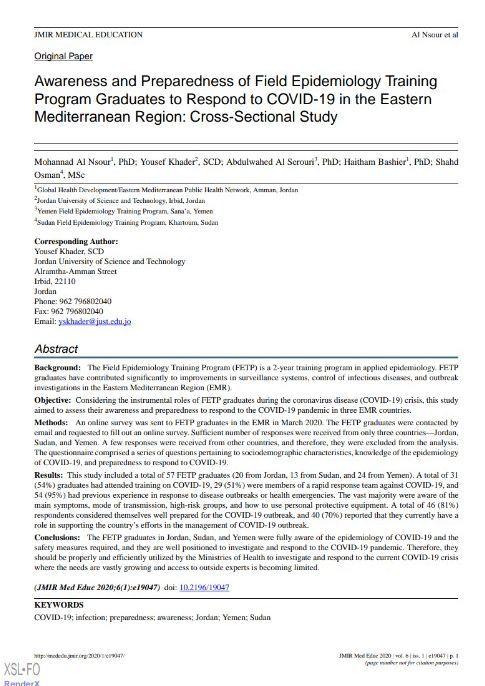

The JMIR Medical Education article Awareness and Preparedness of Field Epidemiology Training Program Graduates to Respond to COVID-19 in the Eastern Mediterranean Region: Cross-Sectional Study assesses how prepared Field Epidemiology Training Program (FETP) graduates were to respond to COVID-19. Published on 18 September 2020, the study surveyed 57 advanced FETP graduates from Jordan, Sudan and Yemen, focusing on their knowledge of COVID-19, outbreak-response experience, safety practices and preparedness.
Key Insights
The study included 57 graduates: 20 from Jordan, 13 from Sudan and 24 from Yemen. Around 81% worked for their national Ministries of Health.
Previous emergency-response experience was very high: 95% had participated in disease outbreak or health emergency responses, while 51% were members of COVID-19 rapid response teams.
Knowledge of COVID-19 was generally strong. All respondents identified fever and cough as key symptoms and recognized coughing and sneezing as a transmission route.
Safety preparedness was also high. All respondents knew how to use personal protective equipment, while 88% knew how to conduct isolation procedures.
Around 81% considered themselves well prepared to respond to COVID-19, and 70% were already supporting their country’s pandemic response.
National preparedness was viewed less positively. Only 46% believed their countries were prepared to manage COVID-19, and among this group, 42% were satisfied with national preparedness.
The Ministry of Health was the main information source for 93% of graduates. Television, radio, social media and EMPHNET’s EpiShares platform were also commonly used.
The study recommends that Ministries of Health make greater use of FETP graduates during emergencies and expand frontline, intermediate and advanced FETP training to address public health workforce shortages.
The study has a limited sample, covering only three countries because responses from other EMR countries were insufficient for analysis. No major numerical inconsistency is apparent.
