






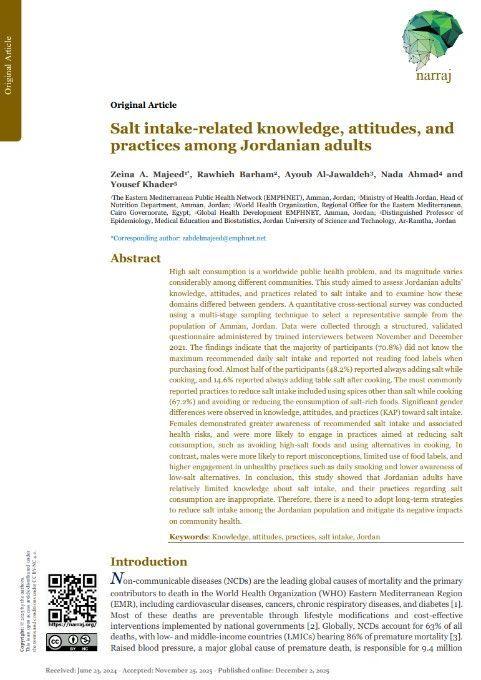

The Narra J original research article Salt Intake-Related Knowledge, Attitudes, and Practices Among Jordanian Adults examines awareness and behaviors related to dietary salt consumption among adults in Amman. Published on 2 December 2025, the study surveyed 1,354 adults and assessed knowledge of recommended salt intake, health risks, food-label use, cooking practices, gender differences and barriers to reducing salt consumption.
Key Insights
Knowledge of recommended salt intake was limited: 70.8% did not know the recommended maximum daily intake, although 96.1% recognized the link between excess salt and hypertension.
Food-label use was very low. Table 4 on pages 5–6 shows that only 17.1% reported reading nutrition labels while grocery shopping.
Salt use during cooking was common: 48.2% always added salt while cooking, 14.6% always added salt at the table, and 46.8% regularly used salty seasonings such as Maggi or chicken broth.
Females generally showed greater awareness and more salt-reduction behaviors than males, including avoiding high-salt foods and using alternatives during cooking.
Table 5 on page 6 shows the most common reduction practices were using spices other than salt (67.2%) and reducing salt-rich foods (64.2%).
Health centers and social media were the preferred sources of information, selected by 82.8% and 78.2% of participants respectively.
Major barriers included not reading food labels, the high cost of low-salt foods, limited restaurant options and insufficient knowledge of low-salt alternatives.
The study recommends public education, clearer mandatory nutrition labeling, food reformulation, primary-care nutrition counseling and gender-sensitive community interventions.
There are some numerical/reporting inconsistencies. In Table 2, the female “No” response for knowing recommended salt intake is shown as 630 and 68.5%, although 68.5% of 1,042 females would be about 714. Also, page 7 describes the cost of low-salt food as 72.1%, while Table 7 reports 75.0%.
