






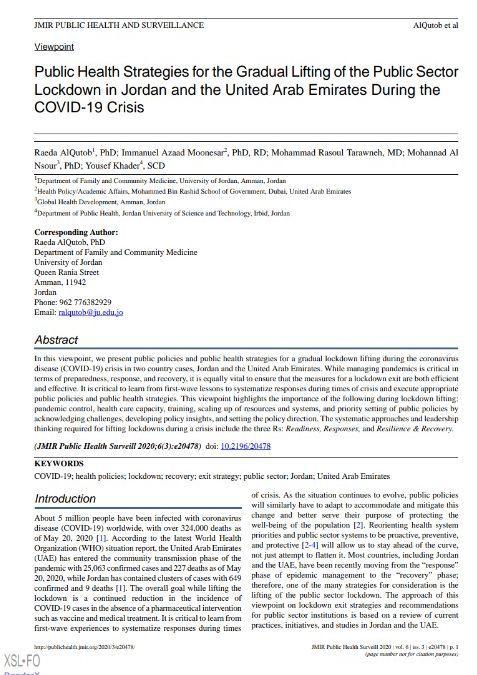

The JMIR Public Health and Surveillance viewpoint Public Health Strategies for the Gradual Lifting of the Public Sector Lockdown in Jordan and the United Arab Emirates During the COVID-19 Crisis examines how Jordan and the UAE could safely reopen public-sector institutions during COVID-19. Published on 21 July 2020, it proposes a phased framework based on preparedness, surveillance, health-system capacity, public engagement and recovery planning.
Key Insights
The article argues that lockdowns should be lifted gradually and only while transmission is declining, cases can be detected quickly and contacts can be traced and isolated.
It proposes the “3 Rs” framework shown in Figure 1 on page 3: Readiness, Response, and Resilience & Recovery.
Readiness includes coordinating emergency task forces, training investigation teams, expanding testing capacity and preparing hospitals for possible increases in cases.
The paper recommends maintaining strong surveillance during reopening, including testing high-risk groups, contact tracing, sentinel surveillance and monitoring workplaces and crowded institutions.
Health-service preparedness should include at least a 20% increase in capacity to accommodate possible surges. The article also highlights field hospitals and additional testing capacity.
Public engagement and communication are central. Governments should clearly communicate distancing, personal protection and reporting requirements while involving communities and civil society.
Reopening should be phased by sector and local risk. Priority should be given to essential sectors such as health and food security, with monitoring after each stage and the possibility of reinstating restrictions if cases increase.
The recovery phase should document lessons learned, strengthen health-system resilience and maintain surveillance and telehealth services.
