
Enmaeya LogoEnmaeya Logo
Home
News
Opinion
Hub
Calendar
Studio
Chat Room
Search
Login
Login
Burger Logo
enmaeya
Search
Home
News
Opinion
Calendar
Studio
Hub
Chat Room
About Us
Enmaeya team
Privacy Policy
Terms and Conditions
Social Media
Contact Us
tel:+96103258219
+961 03 258 219
mailto:info@enmaeya.com
[email protected]
mailto:support@enmaeya.com
[email protected]
Overview
Events
Resources
Partners in development
Logo
footerLogo
Subscribe to our newsletter
Quick Links
Home
News
Opinion
Chat Room
Enmaeya hub
Overview
Events
Resources
Partners in development
Enmaeya Studio
Studio
Interviews
Podcast
Programs
By Partners in development
Get to know us
About Us
Enmaeya team
Privacy Policy
Terms and Conditions
© 2024 Enmaeya, LLC. All Rights Reserved. Use of this site constitutes acceptance of our Terms of Service, Privacy Policy and Do Not Sell or Share My Personal Information. Indie Space may receive compensation for some links to products and services on this website. Offers may be subject to change without notice.
dtu
Home
Hub
Resources
Risk Factors of Dengue Fever in Urban Areas of Rawalpindi District in Pakistan During 2017: A Case Control Study
dtu
Health
Risk Factors of Dengue Fever in Urban Areas of Rawalpindi District in Pakistan During 2017: A Case Control Study
avatar
N/A
Share
Home
Hub
Resources
Risk Factors of Dengue Fever in Urban Areas of Rawalpindi District in Pakistan During 2017: A Case Control Study
Summary
N/A |Jan. 19, 2022

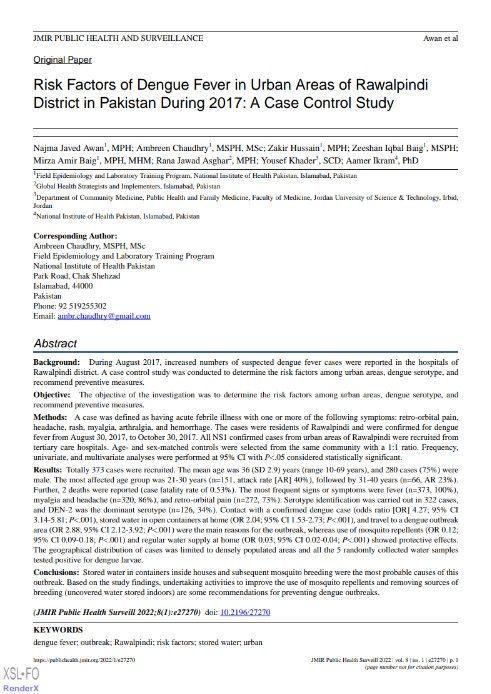
The original paper "Risk Factors of Dengue Fever in Urban Areas of Rawalpindi District in Pakistan During 2017: A Case Control Study" examines the main risk factors associated with a dengue fever outbreak in urban Rawalpindi, Pakistan, in 2017. The study included 373 confirmed cases and compared them with matched controls to identify environmental and behavioral factors linked to infection. It found that household water storage, contact with confirmed dengue cases, and travel to outbreak areas increased the risk, while mosquito repellents and regular water supply had protective effects.

Key Insights

  • The study included 373 confirmed dengue cases, with 75% of cases occurring among males.

  • The 21–30 age group was the most affected, accounting for 40% of cases.

  • Two deaths were recorded, resulting in a case fatality rate of 0.53%.

  • Contact with a confirmed dengue case significantly increased the likelihood of infection.

  • Storing water in open containers at home was an important risk factor because it created mosquito breeding sites.

  • Regular water supply and the use of mosquito repellents were strongly associated with reduced dengue risk.

  • DENV-2 was the most common dengue serotype, representing 39% of tested cases.

  • The study recommends eliminating stagnant and uncovered stored water, promoting mosquito repellents and bed nets, strengthening community awareness, and improving disease surveillance.

More like this
Resource
The Impact of War in Yemen on Immunization Coverage of Children Under One Year of Age
Health
avatar
N/A
Aug. 11, 2026