


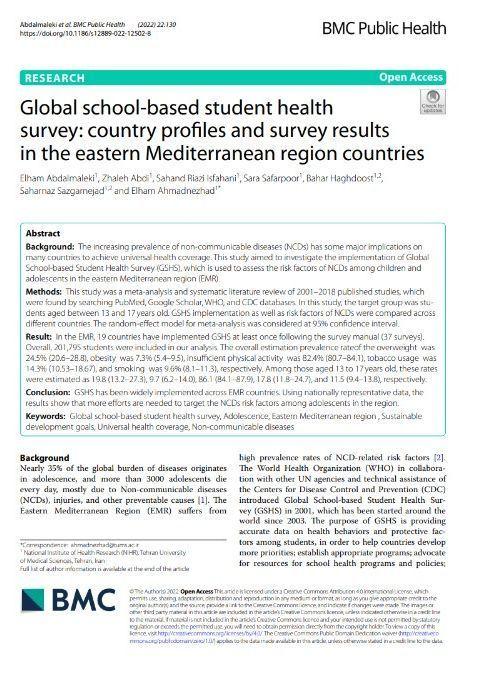

The research paper "Global School-based Student Health Survey: Country Profiles and Survey Results in the Eastern Mediterranean Region Countries" examines the implementation and results of school-based health surveys across the Eastern Mediterranean Region. Using a systematic review and meta-analysis covering 201,795 students, it assesses major risk factors for noncommunicable diseases among adolescents, including physical inactivity, overweight and obesity, tobacco use, and alcohol consumption. The study highlights substantial health risks among adolescents and calls for stronger, more harmonized surveillance and preventive policies across the region.
Key Insights
Nineteen of the 22 Eastern Mediterranean countries implemented the standard Global School-based Student Health Survey at least once during the period studied.
Physical inactivity was the most prominent risk factor, affecting 82.4% of students aged 13–15 and 86.1% of those aged 13–17.
Overweight affected 24.5% of students aged 13–15 and 19.8% of those aged 13–17, while obesity affected 7.3% and 9.7%, respectively.
Tobacco use was also significant, reaching 14.3% among students aged 13–15 and 17.8% among those aged 13–17.
Lebanon recorded particularly high tobacco use, with 31.5% of students aged 13–15 reporting use of tobacco products.
Survey implementation and health indicators varied considerably between countries, limiting direct regional comparisons.
The study identifies physical inactivity as the most urgent modifiable risk factor and recommends stronger school-based interventions, healthier environments, and improved adolescent health surveillance.
