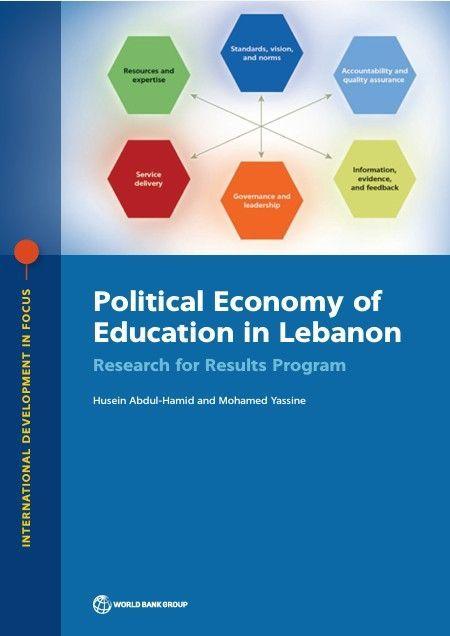

The World Bank report "Political Economy of Education in Lebanon: Research for Results Program" examines how governance, political dynamics, financing, institutional structures, and stakeholder interests influence education quality and reform in Lebanon. Using a mixed-method approach that included more than 1,900 research sources, stakeholder interviews, focus groups, and a nationally representative household survey, the report identifies a significant gap between the public’s positive perception of education and actual learning outcomes. It highlights weaknesses in governance, accountability, equity, teacher management, and evidence-based decision-making, and proposes reforms to strengthen the education system.
Key Insights
Private schools dominate education provision, enrolling 71% of Lebanese students in 2018, compared with 29% in public schools.
Lebanon faces a significant learning crisis: around 60% of 15-year-olds did not reach basic proficiency in mathematics, 63% in science, and 70% in reading in PISA 2015.
Public perception does not reflect actual learning outcomes. While 76% of surveyed households rated education positively, Lebanon ranked only 92nd out of 141 countries in harmonized learning outcomes.
Educational inequality is substantial. Lebanon recorded the largest gap in PISA science performance between the highest and lowest socioeconomic groups among the MENA countries compared in the report.
The system suffers from fragmented and highly centralized decision-making, with political interference and competing stakeholder interests affecting teacher recruitment, resource allocation, and implementation of reforms.
Accountability and quality assurance were identified as the weakest dimensions of the education system, particularly regarding oversight of both public and private schools.
Government education subsidies are poorly targeted: the wealthiest 20% of households received 47% of government education allowances, compared with only 3% for the poorest 20%.
The report recommends stronger governance and institutional capacity, better data and evidence systems, improved teacher management, stronger school accountability, reduced inequalities, and closer coordination between education stakeholders.