






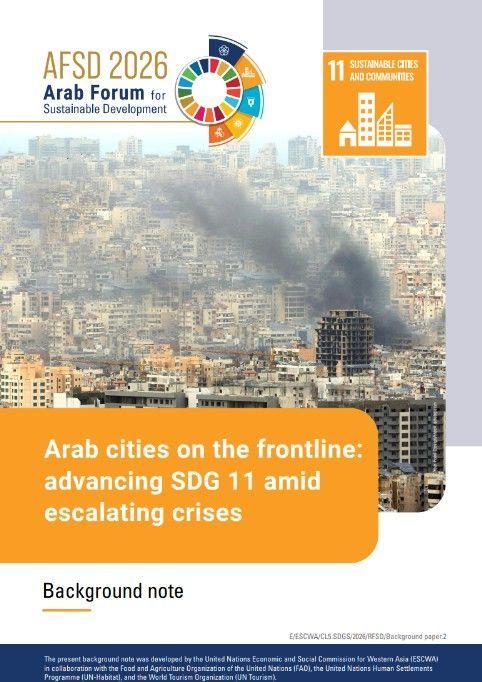

This background note, developed by the United Nations Economic and Social Commission for Western Asia (ESCWA) in collaboration with the Food and Agriculture Organization (FAO), UN-Habitat, and UN Tourism, was prepared for the Arab Forum for Sustainable Development 2026. It assesses progress toward SDG 11 (sustainable cities and communities) across the Arab region, examining how rapid urbanization, conflict-driven displacement, and climate change are straining urban governance, housing and infrastructure, and sets out policy pathways to accelerate progress.
Key Insights
Three out of four inhabitants of the Arab region are projected to live in cities by 2050, with urbanization having risen from 25% to 61% since 1950.
20.9% of the region's population was living in slums, informal settlements or inadequate housing in 2022, little changed from 20.6% in 2016.
North Africa saw urban slum populations fall from around 32% in 2000 to 17% in 2024 through slum upgrading and public housing programmes, while rates remain above 40% in conflict-affected Syria and Yemen.
By 2022, only about half of the region's urban population had convenient access to public transport, ranging from just 8% in Baghdad and 10% in Amman to 62% in Doha and 79% in Marrakesh.
The region hosts more than 15 million refugees, over 35% of the global refugee population, with the majority remaining within the region.
Lebanon recorded over 1 million internally displaced persons in March 2026, one in five inhabitants, straining housing, water, electricity and waste management services in host cities.
In Gaza, urban destruction has reached unprecedented levels, with large-scale destruction of homes, roads and water, sanitation and hygiene infrastructure rendering entire areas uninhabitable.
Airstrikes and evacuation orders in southern Lebanon in early 2026 have damaged residential neighbourhoods, transport infrastructure and municipal services, echoing patterns of destruction seen in Gaza.
Cities such as Beirut, Amman, Erbil and Aden continue absorbing displaced populations under severe fiscal constraints, while Jordan stands out for integrating displaced populations into national and municipal housing and social protection systems.
Municipalities across the region face declining revenues, damaged assets and rising operational costs as conflict, climate risks and economic instability combine to produce cascading shocks for urban systems.
Recommended policy pathways include embedding urban priorities in national development and recovery plans, strengthening local governance and municipal fiscal autonomy, building capacity for inclusive urban management, institutionalizing urban observatories for evidence-based planning, and mobilizing financing and partnerships for reconstruction and long-term resilience.