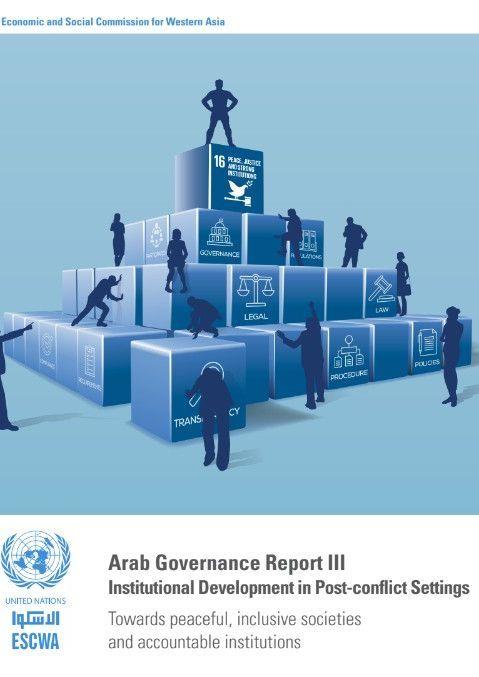

Arab Governance Report III, the third edition in this series from the United Nations Economic and Social Commission for Western Asia (ESCWA), examines institutional development and governance reform in post-conflict Arab settings. Framed around Sustainable Development Goal 16 on peace, justice and strong institutions, it synthesizes international and regional best practices for rebuilding security, judicial, administrative and political institutions after civil war, applies this framework through case studies of Iraq, Libya and Yemen, and closes with an ESCWA statistical analysis of 109 post-war episodes since 1970 identifying the drivers of civil-war relapse risk.
Key Insights
Since 1990 there have been 95 armed conflicts worldwide, 87 of them internal, and all 16 conflicts recorded between 2015 and 2016 were intrastate; 40% of Arab countries have been immersed in or lived through armed conflict in the past six years.
In the Syrian Arab Republic, an estimated 2.3 million people, 10% of the population, were killed or wounded, half the population had fled as refugees or IDPs by 2015, GDP contracted by 55%, and poverty affected half the remaining population, up from 13% before the conflict.
In Yemen, multidimensional poverty reached 60%, GDP per capita declined by 42%, 14 million people needed international humanitarian aid, and two-thirds of children suffered from malnutrition.
The Arab region hosts 31 million refugees and internally displaced people, and the risk of becoming a refugee is 30 times higher for those born in the region than elsewhere.
Roughly half of all post-war countries lapse back into civil conflict between the same belligerents within the first decade after fighting ends.
ESCWA's statistical study of 109 post-war episodes since 1970 found that democracies have an 82% lower risk of conflict relapse than other regime types, and holding nationwide elections within the previous five years reduces relapse risk by about 56%, while delaying elections increases relapse likelihood by 6% for every year postponed.
The presence of non-UN foreign troops almost triples the risk of relapse, and no country rated "free" by Freedom House on civil liberties has relapsed into civil war since 1970.
Economic growth's effect on relapse risk is time-dependent: in the initial post-war months, 5% annual per capita GDP growth is associated with 25% greater relapse risk, but by month 75 the same growth rate is associated with a 50% reduction in relapse risk.
Yemen's World Bank Doing Business ranking dropped to 179 out of 190 economies in 2017, down from 137 out of 189 in 2014, while 26% of businesses in industry, trade and services had closed by 2016.
More than 7 million people in Yemen were on the verge of starvation, cholera cases reached half a million by August 2017 with nearly 2,000 deaths, and only 40% of the population had electricity access.
Libya's 2015 audit bureau found 1.5 million public administration employees, including an estimated 500,000 "ghost workers" duplicated on the payroll, while 64% of the population is concentrated in five major coastal cities.