


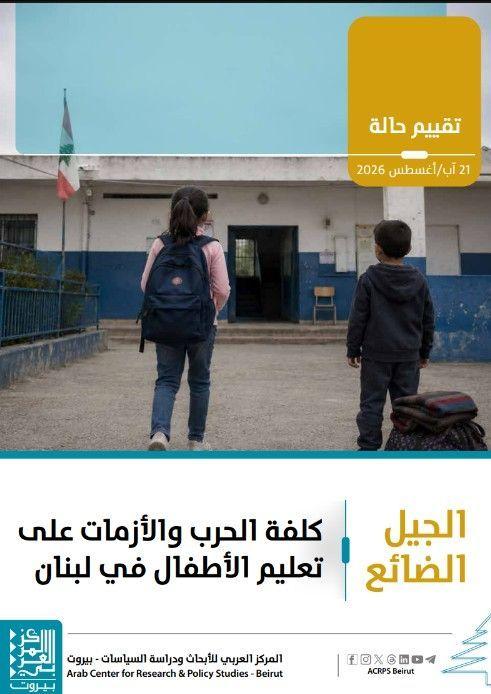

The assessment "The lost generation: the cost of war and crises on children's education in Lebanon" examines how years of economic collapse, COVID-19 disruptions, teacher strikes, political instability and successive wars have compounded Lebanon's education crisis. Published by the Arab Center for Research and Policy Studies – Beirut, it argues that the 2026 war deepened an already severe learning crisis, particularly for children dependent on public education. Drawing on national learning assessments and emergency data, it documents learning loss, displacement, school closures, mental health pressures and attacks on education, and calls for education to become a core component of emergency response rather than being postponed until schools reopen.
Key Insights
Lebanese students had already lost the equivalent of three out of every five learning days because of repeated disruptions before and during the recent crises.
More than half of Grade 1 students lacked basic mathematics skills, while more than eight out of ten Grade 6 students were unable to master division.
Learning gaps widen substantially as children progress through school: estimated literacy delays rise from around nine months in Grade 1 to about two years in Grade 3 and as much as four and a half years by Grade 6.
At the height of the emergency, around half of Lebanon's public schools were being used as collective shelters, disrupting the education of more than 250,000 students.
More than half of displaced children living in collective shelters assessed during the emergency were not enrolled in primary education.
Six out of ten displaced adolescents assessed were not enrolled in secondary education, showing that older children faced particularly serious risks of prolonged disengagement and dropout.
More than eight out of ten displaced families reported needing internet access and digital devices for learning, highlighting major barriers to relying on remote education during displacement.
The crisis also had a major psychological impact: seven out of ten children showed symptoms associated with anxiety, while nearly six out of ten showed symptoms associated with depression.
More than 40,000 children were living in collective shelters covered by the assessment, where mental health and psychosocial support was identified among the most significant unmet needs.
Reports cited in the assessment indicate that more than 100 schools were destroyed or severely damaged, reinforcing the need for systematic national monitoring of attacks on education and their consequences.
The assessment argues that closing schools imposes costs beyond lost learning because schools also provide children with protection, daily social interaction, routine, stability, psychosocial support and links to other essential services.
Lebanon's main challenge was not a lack of evidence or planning frameworks, but a gap between evidence and implementation: learning continuity was formally identified as a priority, yet many displaced children remained without meaningful access to education.
Before the government's decision to cancel official examinations, an estimated US$3–4 million in financial and administrative resources had been directed toward organizing them, raising questions about whether resources were aligned with children's recovery and learning needs.
The assessment recommends treating education as part of the first humanitarian response, prioritizing foundational literacy and numeracy, bringing learning opportunities to displaced children, removing administrative barriers, institutionalizing monitoring of attacks on education and applying the best interests of the child to emergency education decisions.