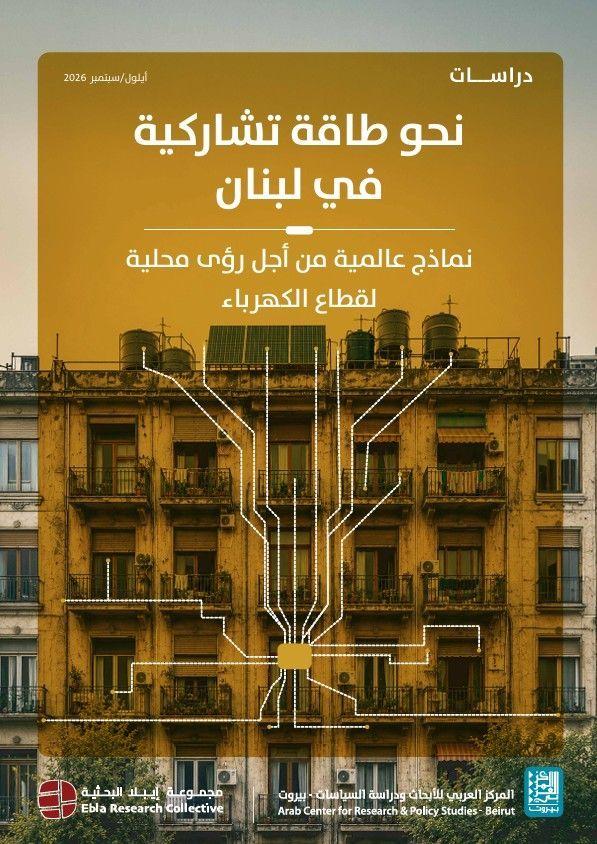
The study “Towards Collaborative Energy in Lebanon: Global Models for Local Visions for the Electricity Sector,” published in September 2026 by the Ebla Research Collective in collaboration with the Arab Center for Research and Policy Studies – Beirut, examines how community-based and collaborative energy models could inform Lebanon’s electricity transition. Drawing on a review of international experiences and seven key informant interviews, the study looks beyond technical solutions to focus on governance, ownership, financing, participation and regulation. It argues that Lebanon’s emerging solar and decentralized energy arrangements—from municipal initiatives to neighborhood and building-level systems—could contribute to a more equitable energy transition if supported by stronger legal and institutional frameworks.
Key Insights
Lebanon’s rapid solar expansion has largely been financed by households, businesses, diaspora communities and donors, while access remains highly unequal between those able to invest privately and lower-income communities.
The study identifies six international models of collaborative energy, ranging from resident-led building initiatives and neighborhood projects to large cooperatives, municipality-led partnerships and community-investment models.
Lebanese examples in Qabrikha, Baaloul, Hasbaya, Bint Jbeil, Nabatieh, Tripoli and Beirut show emerging forms of shared ownership, financing and decision-making, but most remain informal, fragmented and dependent on local leadership or external funding.
The report argues that the Distributed Renewable Energy Law is an important step, but additional reforms are needed to enable energy cooperatives, collective ownership, democratic governance and community participation as part of Lebanon’s broader electricity-sector reform and post-war reconstruction.