



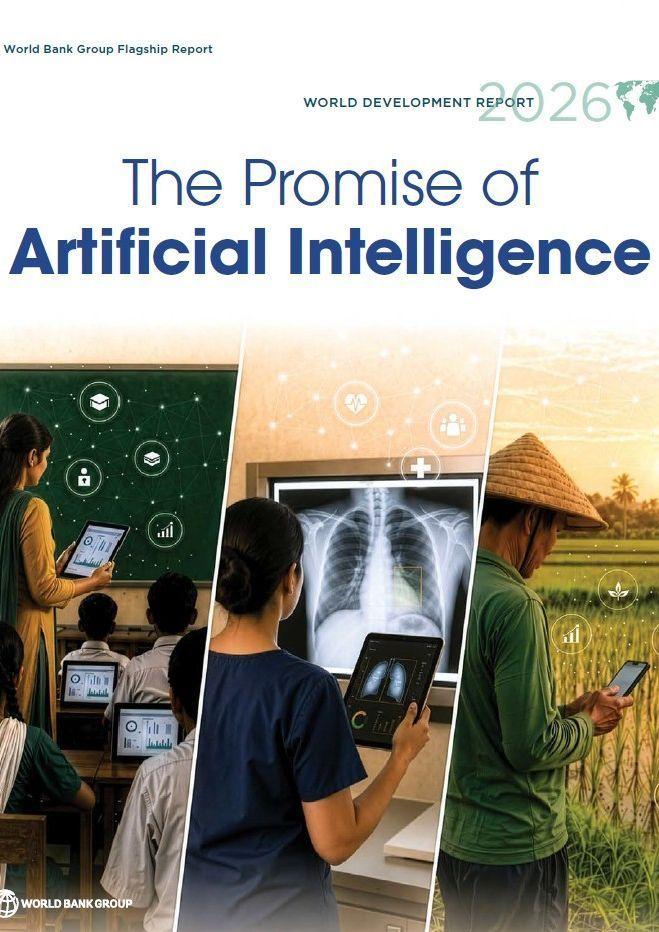

World Development Report 2026: The Promise of Artificial Intelligence, issued by the World Bank Group, examines how AI could shape development in low- and middle-income countries. It argues that countries do not need to compete at the technological frontier to benefit; instead, the priority should be to adopt existing AI, adapt it to local needs, and build the foundations needed to use it productively, while managing risks linked to jobs, inequality, dependence, misinformation and weak governance.
Key Insights
The report’s core framework is capabilities, concentration and complements: AI can expand scarce expertise, but its benefits depend on infrastructure, skills, data and institutions, while advanced AI remains concentrated in a few countries and firms.
Its main policy pathway is “adopt, adapt, then advance”, with most developing countries encouraged to focus first on using and localizing existing tools rather than building frontier models.
AI is expected to complement more jobs than it automates in developing economies, although entry-level knowledge work, outsourcing, ICT and business services face greater disruption risks.
The report highlights small, locally adapted AI applications in agriculture, health, education and public services as potentially more useful for development than large-scale investments in frontier AI systems.
Governments are positioned as enablers, users and regulators, responsible for strengthening connectivity, skills, data and public-sector capacity while creating flexible safeguards and reducing dependence on single technology providers.