

MENA – Cities across the Middle East and North Africa have significant potential to drive job creation and economic growth, but challenges including congestion, housing affordability, weak connectivity, and limited labour mobility continue to prevent many urban areas from fully translating urban growth into employment opportunities, according to a new World Bank report.
The flagship report, “Cities that Work: Realizing the Jobs Potential of MENA’s Cities,” benchmarks 615 cities across MENA against 8,426 cities worldwide to identify the urban factors most closely linked to stronger employment and productivity outcomes.
The report finds that local urban conditions play a significant role in determining cities’ economic performance. While MENA cities benefit from large populations and strategic geographic locations, many face constraints that limit their ability to create productive jobs and attract investment and talent.
To address these challenges, the report proposes a framework built around four key pillars: productive density, market connectivity, attractiveness to investment and talent, and public-private coalitions.
The first pillar focuses on strengthening productive density by ensuring that infrastructure, public services, and land use support business growth and economic activity.
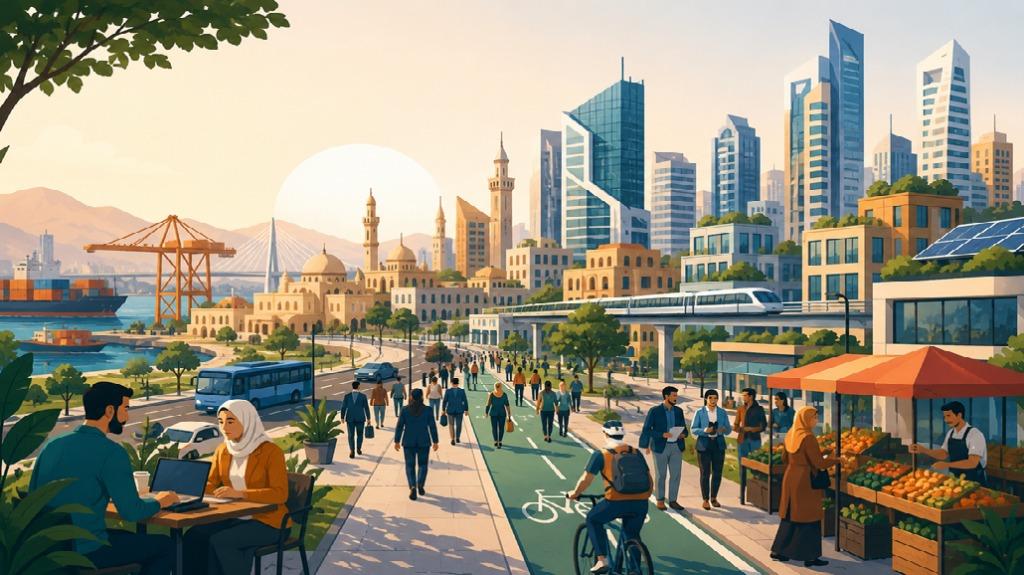
The second highlights the importance of market connectivity, which extends beyond trade infrastructure to include digital access, affordable housing, and reliable urban transport. According to the report, better-connected cities can improve access to jobs, strengthen connections between workers and employers, and support the growth of sectors that compete in regional and global markets.
The report also emphasizes the need to make cities more attractive to investors, businesses, and skilled workers through better housing, improved quality of life, skills development, and business-friendly environments.
Meanwhile, stronger cooperation between governments and the private sector is identified as essential to aligning urban planning, infrastructure investment, and job creation strategies.
The report notes that priorities should differ depending on the size and role of each city. Large and primary cities should focus on economic diversification, expanding tradable sectors, improving metropolitan integration, and attracting investment. Smaller and medium-sized cities, meanwhile, should prioritize reliable basic services, stronger connections to larger markets, and the development of their local economic strengths.
As MENA faces the challenge of creating millions of jobs for its growing and youthful population, the World Bank stresses that strategic investments in infrastructure, housing, transport, connectivity, and governance can help cities become more competitive, productive, resilient, and inclusive.
Ultimately, the report argues that well-planned urban policies can help MENA’s cities unlock more and better jobs, strengthen economic resilience, and turn urbanization into a stronger driver of long-term growth.