LEBANON– Amid successive economic crises and mounting pressures on the Lebanese labour market, finding a job or returning to employment has become a challenge that goes beyond simply securing a vacancy.
For the most vulnerable groups, entering or re-entering the labour market may require access to relevant skills, vocational training, transportation and care services, and financing, alongside a labour market capable of providing genuine and sustainable opportunities.
This is where the new National Economic Inclusion Strategy comes in.
The strategy seeks to move away from a model primarily focused on assistance towards an approach that links social protection with economic participation and greater self-reliance.
Launched by the Ministry of Social Affairs, with technical support from the International Labour Organization (ILO) and funding from the European Union, the strategy aims to strengthen the links between social protection, skills development, employment and entrepreneurship.
From Social Protection to Economic Empowerment
For Minister of Labour Mohammad Haidar, moving towards greater economic independence requires a gradual shift from a model centred on providing assistance to one focused on economic empowerment.
In an exclusive interview with Enmaeya, Haidar explained that social protection should serve as a starting point for integration into the labour market, rather than a permanent substitute for employment.
This requires strengthening active labour market policies, developing public employment services, expanding career guidance and counselling, and improving mechanisms that connect jobseekers with employers.
The approach also includes linking social protection programmes with training, reskilling and employment opportunities, enabling beneficiaries of support programmes to acquire the skills demanded by the labour market and increase their chances of securing decent jobs.
It also involves developing vocational training and reskilling programmes in cooperation with the private sector, while promoting entrepreneurship and small and medium-sized enterprises by facilitating access to business development services and available financing opportunities.
In this way, the strategy offers multiple pathways to economic participation, whether through securing a job, self-employment or launching a business.
When Training Leads to a Job
The key challenge facing any employment strategy remains ensuring that training actually leads to employment. Obtaining a training certificate does not necessarily translate into entering the labour market if the skills acquired do not match employers’ needs.
In this regard, Haidar said the Ministry of Labour is working to strengthen labour market information systems to identify in-demand occupations and skills, while involving the private sector in identifying skills needs and designing training programmes to ensure they align with the requirements of different economic sectors.
The ministry also seeks to expand practical and on-the-job training programmes, giving beneficiaries hands-on experience and improving their chances of moving into permanent employment. Training programmes are expected to focus on sectors with strong potential for growth and job creation, including the digital economy, modern agriculture, food industries, renewable energy and services.
This also involves strengthening coordination between the Ministry of Labour, educational institutions, and technical and vocational education and training institutions, with the aim of updating curricula in line with technological developments and employers’ needs.
Under this approach, the goal is for training not to end with the acquisition of a certificate, but to become a genuine pathway into the labour market.
Reintegrating Those Who Have Lost Their Jobs
These efforts come at a time when Lebanon’s labour market is facing significant pressures. According to an ILO survey, it was noted during the launch of the strategy that around one-third of private-sector workers had lost their jobs since March, with women, young people and persons with disabilities affected more severely.
In this context, the Ministry of Labour is working to support the reintegration of people who have lost their jobs by strengthening public employment services, improving registration mechanisms, and enhancing counselling and mediation services between jobseekers and employers.
The efforts also include reskilling and upskilling programmes for workers who have lost their jobs, with a focus on sectors capable of growth, as well as cooperation with the private sector on on-the-job training programmes and employment incentives.
The ministry also views small and medium-sized enterprises and entrepreneurship as important sources of job creation at the current stage, while working to facilitate access to business development services and available support programmes.
At the same time, the ministry seeks to strengthen labour market information systems to guide training and employment programmes towards the occupations and skills that employers actually need.
Decent and Sustainable Jobs
However, the success of economic inclusion cannot be measured solely by the number of jobs created. According to Haidar, the quality and sustainability of jobs are no less important than their number. The Ministry of Labour therefore seeks to direct its interventions towards productive and decent employment opportunities, in line with national and international labour standards and the Sustainable Development Goals.
Measures include strengthening compliance with labour standards, protecting workers’ rights, improving occupational health and safety conditions, and reducing forms of precarious and inadequate work.
The ministry is also focusing on supporting the transition from the informal to the formal economy, enabling workers to benefit from legal and social protection while strengthening the stability of employment relationships.
Ultimately, the question is not simply whether a person has found a job, but whether that job provides stability, protection and a genuine opportunity to build a sustainable source of income.
The Private Sector as a Partner in Implementation
The strategy places the private sector at the heart of economic inclusion efforts, recognising it as a key partner in expanding employment opportunities.
Haidar said the ministry expects companies and businesses to contribute to providing employment opportunities based on merit and equal opportunity, thereby improving access to the labour market for young people, women, persons with disabilities and other vulnerable groups.
The private sector is also expected to participate in the design and implementation of training and reskilling programmes to ensure that the skills acquired correspond to the actual needs of businesses, while providing practical and on-the-job training opportunities.
These steps can help young people and recent graduates transition from education to employment and reduce the experience gap that often represents a barrier to securing a first job.
At its core, this model is based on a partnership between government, employers, workers, civil society and international partners.
Women, Youth and Persons with Disabilities
Economic inclusion cannot be effective unless it reaches those most at risk of exclusion from the labour market. For this reason, women, young people and persons with disabilities are at the centre of the strategy, given the greater barriers these groups face in accessing employment opportunities.
Haidar explained that the ministry is working to design labour market policies that take into account the needs of groups most vulnerable to exclusion, while monitoring the outcomes of these policies through clear indicators, including women’s labour force participation rates, youth employment and the integration of persons with disabilities into the labour market.
The aim is to make economic inclusion a measurable and assessable process, rather than simply a stated objective.
How Will Success Be Measured by 2030?
The results of the strategy will be measured by 2030 based on its actual impact on the labour market and the lives of target groups, rather than simply by the number of programmes implemented or people who have received training.
Monitoring indicators will include increased labour force participation, particularly among women, young people and persons with disabilities, as well as improved employment rates and lower unemployment, with a focus on long-term unemployment and youth unemployment.
The quality of new jobs will also be assessed through indicators including job retention, wage levels, access to social protection and compliance with decent work standards.
The ministry will also monitor the effectiveness of training programmes by measuring the proportion of participants who secure employment after completing training and the extent to which they remain employed over an appropriate period. It will also assess how well acquired skills match employers’ needs through their feedback and evaluations.
In addition, the ministry will monitor progress towards greater formalisation of the economy and expanding workers’ access to legal protection.
By 2030, therefore, the question will not simply be: How many people entered a training programme? It will be: What happened to them afterwards? Were they able to secure stable employment? Did they remain in their jobs? And did the skills they acquired help them build a sustainable source of income?
What Is the Strategy Really Testing?
The National Economic Inclusion Strategy comes at a time when Lebanon is facing a combination of unemployment, job losses, economic instability and growing pressures on the most vulnerable households.
In this context, the challenge is not simply to create new jobs, but to build a system that connects people with the skills, services and opportunities they need to participate in the economy.
For the Ministry of Labour, this requires strengthening employment services, developing training systems, deepening cooperation with the private sector and promoting entrepreneurship, while ensuring that employment opportunities are decent and protected.
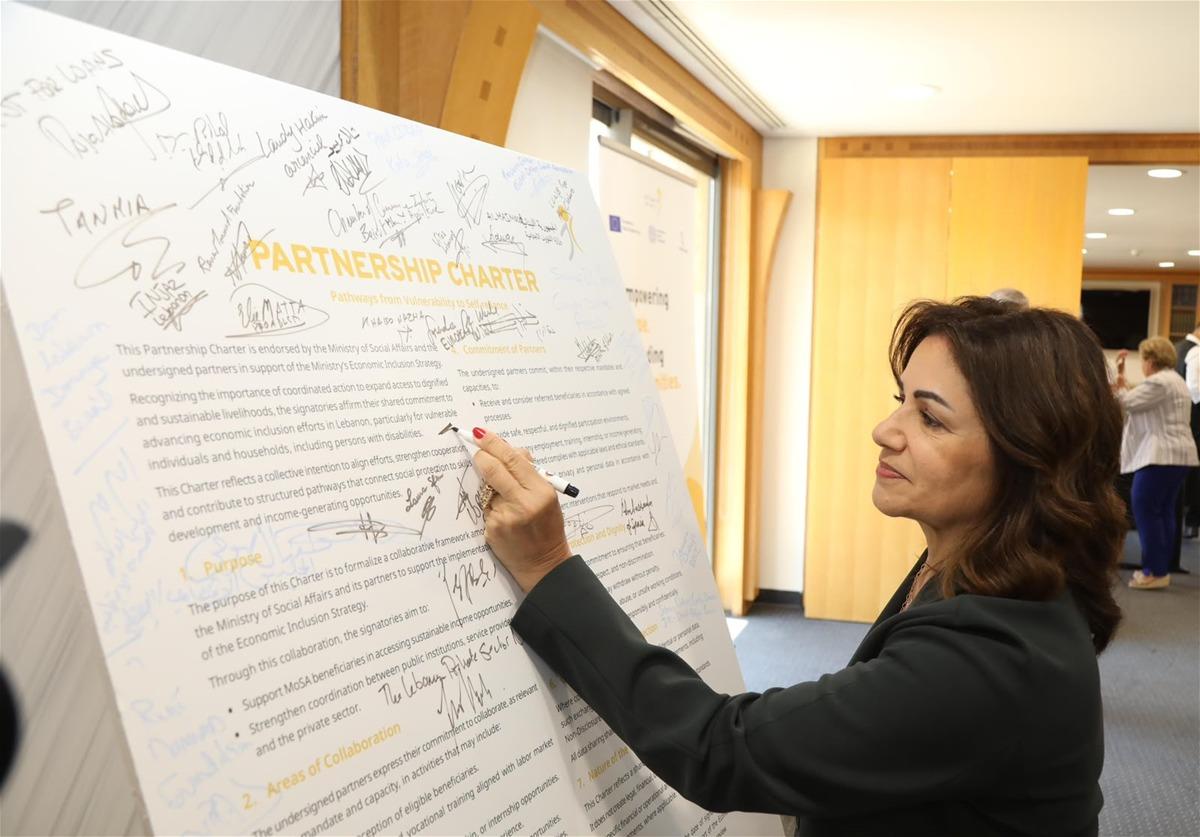
The European Union has invested more than €20 million in economic inclusion programmes in Lebanon between 2023 and 2026, according to EU Ambassador to Lebanon Sandra De Waele, who renewed the EU’s support for implementing the strategy. The launch of the strategy also saw the signing of an Economic Inclusion Partnership Charter between the Ministry of Social Affairs and a number of public and private entities, financial and development institutions, and civil society organisations.
But the real test of the strategy will not be the number of programmes, partnerships or training certificates launched.
It will be whether a worker who has lost their job can return to stable employment; whether a young person can acquire a skill that employers genuinely need; whether a woman can enter and remain in the labour market without barriers to her advancement; and whether a person with a disability can access a fair and genuine opportunity to earn a living.
Ultimately, if Lebanon succeeds in building this bridge, the National Economic Inclusion Strategy could mark a step towards a more inclusive, productive, resilient and sustainable labour market.