







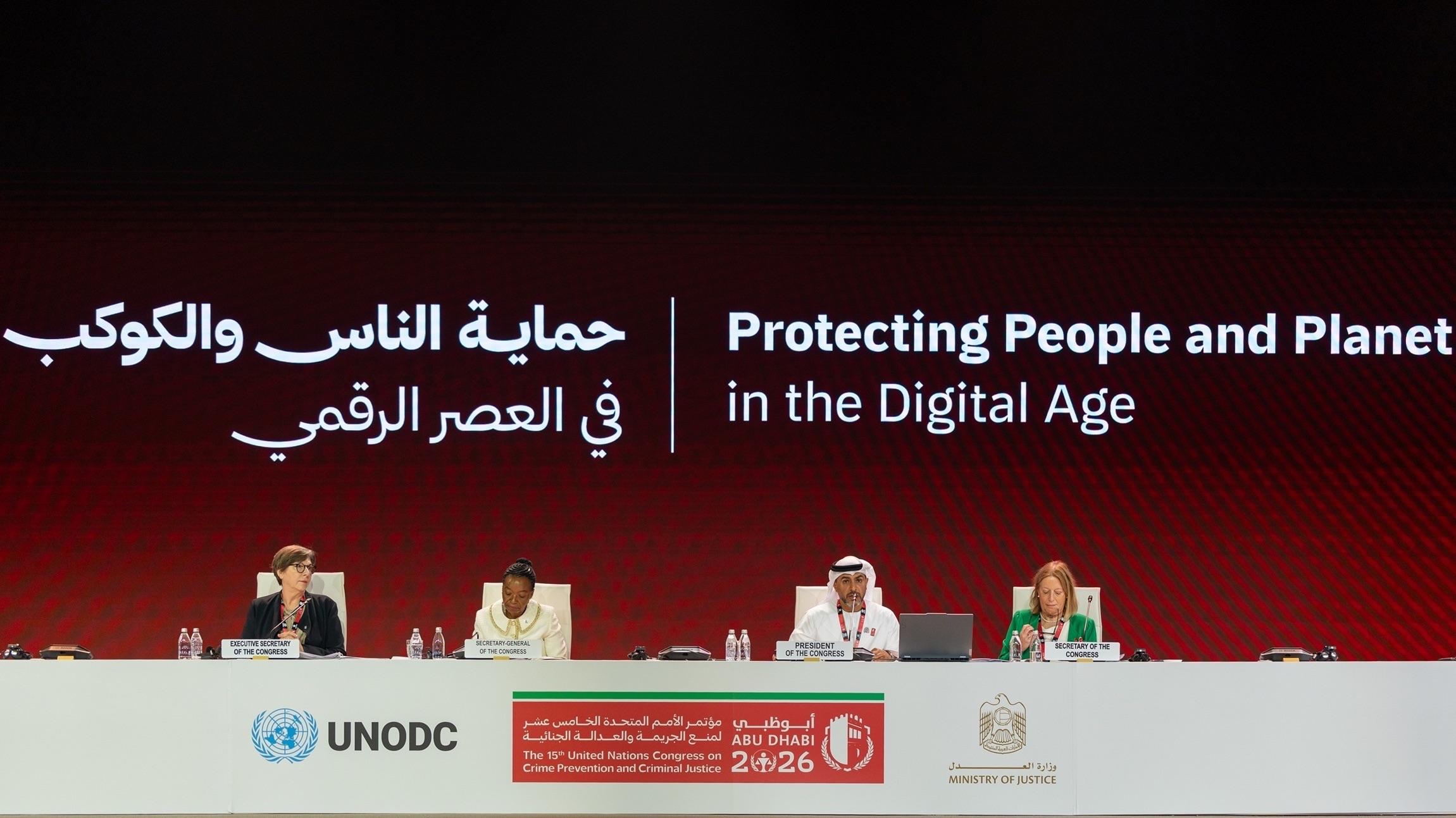
UNITED ARAB EMIRATES - The 15th United Nations Congress on Crime Prevention and Criminal Justice concluded in Abu Dhabi on October 1.
It brought together governments, international organizations, civil society, academia and youth representatives to discuss how crime prevention and justice systems should respond to increasingly complex and technology-driven threats.
Held from September 26 to October 1 under the theme “Accelerating crime prevention, criminal justice and the rule of law: protecting people and planet and achieving the 2030 Agenda for Sustainable Development in the digital age,” the Congress focused on four broad areas: crime prevention, people-centred justice, emerging forms of crime, and international cooperation.
Abu Dhabi Declaration
The central outcome was the adoption by consensus of the Abu Dhabi Declaration, which establishes a framework for international action on crime prevention, criminal justice and the rule of law for the coming five years.
The declaration was adopted at the opening of the Congress and will be submitted to the Commission on Crime Prevention and Criminal Justice for consideration.
The declaration responds to changes in the criminal landscape, including cybercrime, fraud, organized and transnational crime, and the exploitation of digital infrastructure. Member States also addressed emerging concepts such as “crime as a service” and “violence as a service.”
Technology was a major part of the discussions. Countries committed to advancing the digitalization of justice systems and using technologies, including artificial intelligence, while emphasizing safeguards such as human oversight, transparency, due process and data protection.
From Commitments to Action
A key feature of the Congress was the Pledge4Justice initiative, designed to translate the declaration into specific national and international actions. More than 60 countries agreed to time-bound commitments extending through 2031.
The pledges cover three broad areas: using technology and innovation while strengthening responses to technology-enabled crime; improving international cooperation against organized and serious crime, including illicit financial flows and asset recovery; and developing more effective, inclusive and people-centred justice systems. Commitments also include crime prevention, access to justice, victim protection, rehabilitation and reintegration.
The UAE also pledged funding to support follow-up to the Abu Dhabi Declaration and help keep the commitments on the international agenda through 2031.
Protecting People, Communities and the Environment
Crime prevention was discussed not only as a law-enforcement issue but also in connection with social and economic development. Sessions examined evidence-based prevention strategies, resilient communities, protection of women, children and youth, equal access to justice, and better use of crime data.
Environmental crime was also among the issues addressed, reflecting growing concern over crimes affecting ecosystems and natural resources. The Congress linked effective crime prevention and criminal justice systems with broader efforts to advance the UN 2030 Agenda for Sustainable Development.
Greater Youth Participation
Youth engagement was another notable feature of the Congress. A Youth Forum was held on September 24 and 25, while young participants contributed to plenary discussions and workshops and presented recommendations during the Congress. The UN described the Abu Dhabi gathering as the most youth-inclusive Crime Congress to date.
The Congress brought together representatives from 119 countries, with more than 5,100 participants from Member States, the private sector, civil society and academia, according to UN figures.
The next stage will be implementation: translating the Abu Dhabi Declaration and national pledges into measurable action, while continuing discussions through UN crime-prevention and criminal-justice bodies.


