

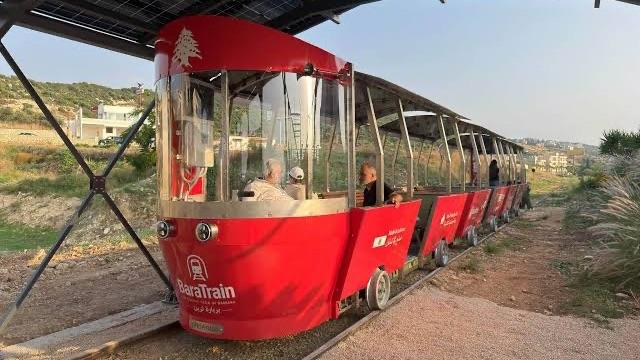
Lebanon — Lebanon launched its first electric train on October 9, introducing a small-scale transport initiative along part of the country’s historic coastal railway in an effort to revive rail travel after decades of inactivity and promote more sustainable mobility.
The project, named BaraTrain, was inaugurated on the main road near Barbara’s port in the Jbeil district. It was organized jointly by the municipality and the Railway and Public Transportation Authority, under the patronage and in the presence of Public Works and Transport Minister Fayez Rasamny and Tourism Minister Laura El Khazen Lahoud.
The initiative uses part of the old railway route between Barbara and Madfoun Bridge, offering a local example of how disused railway infrastructure could be put to new use.
Gradual Expansion Planned
Minister Rasamny told Anadolu Agency that the project carried particular significance, noting that authorities had begun removing encroachments along railway routes to prepare them for potential reuse.
He highlighted the importance of cooperation between municipalities and the Ministry of Public Works and Transport, as well as partnerships between the public and private sectors.
The train service will expand gradually, Rasamny said, with the number of trips expected to increase from three to 10 and eventually to 20. He also called for funding to support public transport in Lebanon’s 2027 budget, including the provision of buses that do not run on diesel.
Tourism and Sustainable Mobility
Minister Lahoud said the initiative could help connect Lebanese regions, stimulate tourism and economic activity, and ease road congestion through the use of environmentally friendly electric transport.
She expressed hope that the experience could be expanded to other parts of the country.
Barbara Mayor George Moufarrej described the project as a message to the future, saying it renewed interest in railway lines that Lebanese people once used and encouraged cooperation to restore rail transport.
Locally Built, Solar-Powered Train
Carlos Naffa, head of the Tran Tran Association, told Anadolu Agency that although the train was modest in scale, it demonstrated the potential for local initiatives to contribute to restoring Lebanon’s railway network.
He said the municipality was implementing the project in cooperation with the Railway and Public Transportation Authority, which authorized the use of the track. The train was built locally and operates on solar power, he added.
Organizers aim to promote shared transport, improve connections between regions, support environmentally friendly mobility and stimulate economic activity.
Railway Authority Defends Initiative
Ziad Shia, director general of the Lebanese Railway and Public Transportation Authority, defended the project amid criticism, describing it as a step toward reviving the country’s railway system despite limited resources.
In a statement, Shia said the initiative reflected cooperation and the efforts of citizens seeking to preserve Lebanon’s railway heritage. He described the project as modest in scale but significant in its implications, adding that it aimed to reclaim neglected railway areas affected by encroachments.
Shia said the project was intended to offer a sign of hope for the return of trains to Lebanon. He added that the authority was continuing to work with partner countries and international organizations to restore the railway system in line with modern international standards.
The project’s route extends from Barbara to Madfoun Bridge, with hopes that it could eventually contribute to broader rail connections linking Beirut with Tripoli and Akkar, as well as southern Lebanon and the Bekaa Valley.
A Railway Network Inactive for Decades
Lebanon’s railway network dates to the late 19th century, when lines were established to connect Beirut with Damascus and Tripoli and transport passengers and goods.
Rail services declined during the civil war, which began in 1975. The Beirut–Tripoli railway line stopped operating in 1979.
The Barbara initiative marks a local effort to reuse part of the historic coastal railway, although restoring a wider national network would require further development and investment.