


Enmaeya LogoEnmaeya Logo
Home
News
Opinion
Hub
Calendar
Studio
Chat Room
Search
Login
Login
Burger Logo
enmaeya
Search
Home
News
Opinion
Calendar
Studio
Hub
Chat Room
About Us
Enmaeya team
Privacy Policy
Terms and Conditions
Social Media
Contact Us
tel:+96103258219
+961 03 258 219
mailto:info@enmaeya.com
[email protected]
mailto:support@enmaeya.com
[email protected]
Overview
Events
Resources
Partners in development
Logo
footerLogo
Subscribe to our newsletter
Quick Links
Home
News
Opinion
Chat Room
Enmaeya hub
Overview
Events
Resources
Partners in development
Enmaeya Studio
Studio
Interviews
Podcast
Programs
By Partners in development
Get to know us
About Us
Enmaeya team
Privacy Policy
Terms and Conditions
© 2024 Enmaeya, LLC. All Rights Reserved. Use of this site constitutes acceptance of our Terms of Service, Privacy Policy and Do Not Sell or Share My Personal Information. Indie Space may receive compensation for some links to products and services on this website. Offers may be subject to change without notice.
nfcg
Home
Hub
Resources
An Electronic Disease Early Warning System in Sana’a Governorate, Yemen: Evaluation Study
nfcg
Health
An Electronic Disease Early Warning System in Sana’a Governorate, Yemen: Evaluation Study
avatar
N/A
Share
Home
Hub
Resources
An Electronic Disease Early Warning System in Sana’a Governorate, Yemen: Evaluation Study
Description
N/A |Oct. 14, 2019

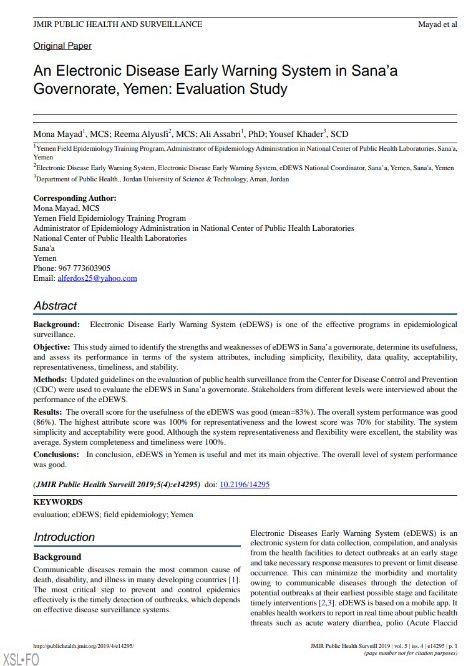
The JMIR Public Health and Surveillance article An Electronic Disease Early Warning System in Sana’a Governorate, Yemen: Evaluation Study assesses the usefulness and performance of Yemen’s electronic Disease Early Warning System (eDEWS). Conducted in Sana’a governorate in 2016, the evaluation used CDC surveillance-system guidelines and examined simplicity, flexibility, acceptability, representativeness, timeliness, completeness and stability.

Key Insights

  • Overall eDEWS performance was rated good at 86%, while its usefulness scored 83%.

  • Representativeness received the highest score at 100%, with the system covering both public and private health facilities.

  • Reporting completeness and timeliness both reached 100%, supporting rapid detection and response to disease outbreaks.

  • Flexibility was rated excellent at 91%, meaning the system could integrate new diseases, information and other surveillance programmes.

  • Stability was the weakest area at 70%, mainly because of donor dependence, network problems in remote areas and insufficient maintenance resources.

  • Figure 1 on page 3 shows the reporting flow from health facilities through districts and governorates to the central eDEWS system, with weekly electronic reporting and feedback.

  • The authors recommend regular feedback to health facilities, stronger government financial support and further evaluation following expansion of the system.

More like this
Resource
Salt Intake-Related Knowledge, Attitudes, and Practices Among Jordanian Adults
Health
Development
avatar
N/A
Aug. 11, 2026