






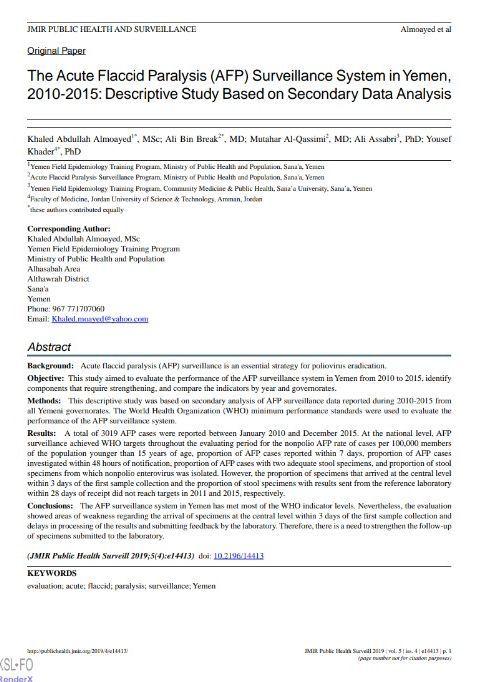

The JMIR Public Health and Surveillance article The Acute Flaccid Paralysis (AFP) Surveillance System in Yemen, 2010–2015 evaluates Yemen’s AFP surveillance system against WHO performance standards. The study analyzes 3,019 AFP cases reported across all governorates between 2010 and 2015, focusing on detection, notification, investigation, stool specimen collection and laboratory processing.
Key Insights
Yemen reported 3,019 AFP cases between 2010 and 2015. Alhudaidah recorded the most cases (363), while Almahara recorded the fewest (29).
The national nonpolio AFP detection rate exceeded the WHO target of 2 cases per 100,000 children under 15 every year, ranging from 3.4 to 5.1.
Case investigation performed strongly: 98–100% of reported AFP cases were investigated within 48 hours, well above the 80% target.
Adequate stool specimen collection also exceeded the national target throughout the period, ranging from 91% to 97%.
Transport of specimens was weaker. Only 75% reached the central level within three days in 2011, below the 80% WHO target.
Laboratory turnaround was a major weakness. Table 1 on page 4 shows that results were returned within 28 days for only 76% of specimens in 2013 and 48% in 2015.
Figure 4 on page 6 shows deterioration in laboratory performance: the proportion of governorates meeting the laboratory turnaround standard fell from 91% in 2012 to 27% in 2013 and 0% in 2015.
The study recommends strengthening specimen follow-up and developing national laboratory capacity to reduce dependence on the NAMRU-3 reference laboratory in Egypt.
