


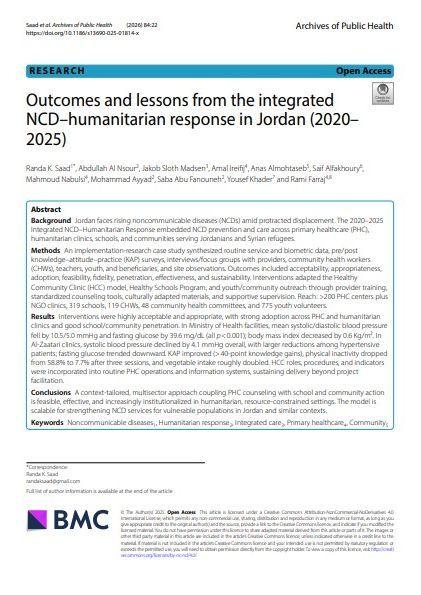

The research paper "Outcomes and Lessons from the Integrated NCD–Humanitarian Response in Jordan (2020–2025)" evaluates a five-year initiative integrating noncommunicable disease prevention and care into primary healthcare centers, humanitarian clinics, schools, and communities serving Jordanians and Syrian refugees. The study assesses clinical outcomes, behavior change, implementation, and sustainability, finding that a multisectoral approach combining healthcare counseling with school and community interventions can improve NCD outcomes and become embedded within existing health systems.
Key Insights
The initiative reached more than 200 primary healthcare and NGO facilities, 319 schools, 119 community health workers, 48 community health committees, and 775 youth volunteers.
In Ministry of Health facilities, participants experienced average reductions of 10.5 mmHg in systolic blood pressure, 5.0 mmHg in diastolic blood pressure, and 39.6 mg/dL in fasting blood glucose.
In Al-Zaatari Camp clinics, systolic blood pressure declined significantly, with greater improvements among patients with hypertension.
Knowledge of hypertension, diabetes, and NCD risk factors improved by more than 40 percentage points among beneficiaries participating in counseling.
Physical inactivity among participants in Save the Children clinics decreased from 58.8% to 7.7% after three counseling sessions, while vegetable intake approximately doubled.
The program successfully connected health services with schools and community outreach, supporting both Jordanian communities and Syrian refugees.
Sustainability was strengthened by integrating the Healthy Community Clinic model into routine Ministry of Health operations, staff responsibilities, training systems, and the national Hakeem health information system.
The findings suggest that integrated, context-specific NCD programs can provide a scalable model for humanitarian and resource-constrained settings
