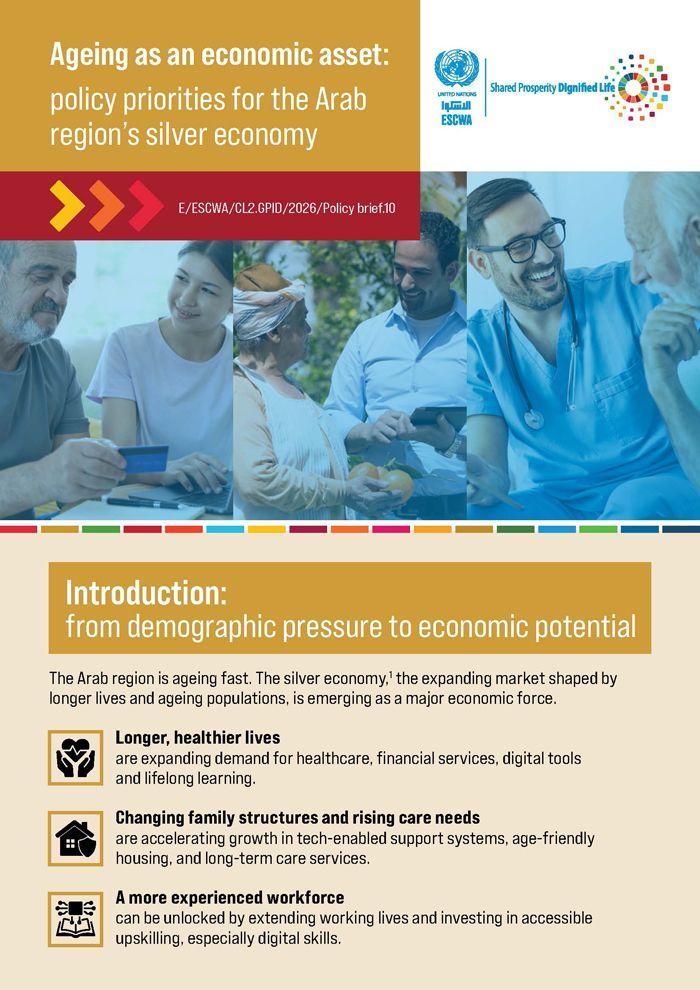

This ESCWA policy brief, “Ageing as an economic asset: policy priorities for the Arab region’s silver economy” (E/ESCWA/CL2.GPID/2026/Policy brief.10), issued in 2026, examines how rapid population ageing in the Arab region can be transformed from a demographic pressure into an economic opportunity through the silver economy, while addressing gaps in care, labour participation, financial security and digital inclusion. Its purpose is to set out evidence and a practical policy agenda—aligned with the Madrid International Plan of Action on Ageing (MIPAA) as highlighted in Box A on page 2—calling governments and the private sector to invest in age-friendly healthcare and long-term care, flexible employment and lifelong learning, inclusive finance and pensions, anti-ageism public awareness, and accessible digital transformation.
Key Insights
The Arab region’s 60+ population rising from 11.5 million in 1990 to 36 million today and nearly 94 million by 2050, increasing its share of total population from 5% to 13%.
Adults’ spending at $752–940 billion by 2050 and an overall economic impact of $827 billion–$1.22 trillion, with the silver economy potentially nearing 20% of regional GDP if GDP reaches about $5 trillion by mid-century.
Limited long-term care and health infrastructure, low labour-force participation due to age bias and scarce upskilling, financial insecurity especially among women and informal workers, digital exclusion, and weak enabling conditions such as data gaps and fragmented regulation.
Regional initiatives highlighted across Boxes B–H —including Altibbi’s telehealth services, the University for Seniors in Beirut, Jordan’s Bank al Etihad Shorouq programme, Qatar’s Mada accessibility model, Saudi Arabia’s National Elderly Survey, Bahrain’s flexible home‑care licensing, and Morocco’s Technopark ecosystem—illustrate scalable pathways to expand age-inclusive services and markets.
The report’s five-part call to action urges investment in age-friendly healthcare and wellness, flexible employment and lifelong learning, innovative pensions and financial products, stigma‑challenging public awareness, and accessible technologies with digital‑literacy support, complementing public responsibilities and advancing MIPAA integration.