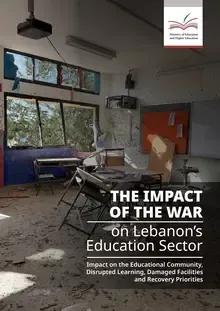

‘The Impact of the War on Lebanon’s Education Sector: Impact on the Educational Community, Disrupted Learning, Damaged Facilities and Recovery Priorities’, issued by the Ministry of Education and Higher Education (MEHE), Government of Lebanon, on 30 September 2026, assesses how the Israeli war on Lebanon since March 2026 has strained an already crisis-affected education system by disrupting learning, displacing learners and staff, and damaging infrastructure. The report documents MEHE’s emergency response and provides an evidence base and strategic framework for a nationally led, partner‑aligned recovery that restores learning, rehabilitates safe and inclusive facilities, supports education personnel and strengthens institutional capacity and preparedness.
Key Insights
Within MEHE’s assessment coverage, 60 schools reported martyrdom or injury among teachers, at least 86 teachers were reported martyred or injured, while approximately 20% of learners and 12% of teachers and other education personnel were reported displaced.
Educational disruption was widespread, with approximately 27% of learners experiencing interruptions, around 200,000 learners in war‑affected areas facing severe disruption, and nearly 100,000 unable to return to their schools due to damage, insecurity or displacement, while educational facilities were also mobilized as collective shelters during displacement.
Of 1,089 educational facilities assessed in accessible areas, 436 reported being affected by at least one attack since 2 March 2026, including 64 classified as severely damaged and 37 as destroyed, about 23% of affected facilities.
MEHE monitoring recorded significant protection and inclusion pressures, with 26.41% of learners within the inclusive education system displaced and a 51.1% increase in identified special educational needs and psychosocial difficulties, alongside recorded child‑protection cases in which self‑harm and suicide attempts were 5.9% and suicidal ideation 3.7% of all recorded forms of violence, indicators drawn from recorded caseloads rather than population prevalence.
MEHE mobilized more than 2,000 staff and sustained onsite, online and hybrid provision, including an Inclusive Education Emergency Response with 195 specialists active in person or hybrid and 123 online, while setting recovery priorities to restore learning, rehabilitate safe and functional learning environments, strengthen well‑being and inclusive education, support education personnel and reinforce institutional capacity through a nationally led, evidence‑based and partner‑aligned plan.