
Enmaeya LogoEnmaeya Logo
Home
News
Opinion
Hub
Calendar
Studio
Chat Room
Search
Login
Login
Burger Logo
enmaeya
Search
Home
News
Opinion
Calendar
Studio
Hub
Chat Room
About Us
Enmaeya team
Privacy Policy
Terms and Conditions
Social Media
Contact Us
tel:+96103258219
+961 03 258 219
mailto:info@enmaeya.com
[email protected]
mailto:support@enmaeya.com
[email protected]
Overview
Events
Resources
Partners in development
Logo
footerLogo
Subscribe to our newsletter
Quick Links
Home
News
Opinion
Chat Room
Enmaeya hub
Overview
Events
Resources
Partners in development
Enmaeya Studio
Studio
Interviews
Podcast
Programs
By Partners in development
Get to know us
About Us
Enmaeya team
Privacy Policy
Terms and Conditions
© 2024 Enmaeya, LLC. All Rights Reserved. Use of this site constitutes acceptance of our Terms of Service, Privacy Policy and Do Not Sell or Share My Personal Information. Indie Space may receive compensation for some links to products and services on this website. Offers may be subject to change without notice.
Screenshot 2026-05-22 151358
Home
Hub
Resources
Who Owns the Shore? A Review of Coastal Access and Violations in Lebanon
Screenshot 2026-05-22 151358
Environment
Who Owns the Shore? A Review of Coastal Access and Violations in Lebanon
avatar
enmaeya
Share
Home
Hub
Resources
Who Owns the Shore? A Review of Coastal Access and Violations in Lebanon
Description
enmaeya |May. 22, 2026

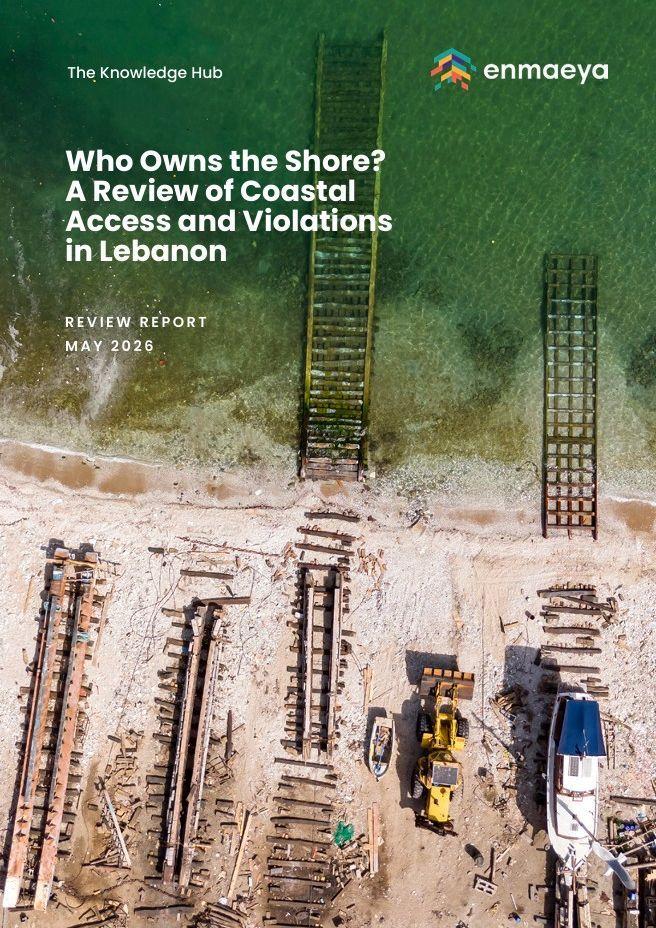
The report examines Lebanon’s coastline as a shared public asset that is increasingly threatened by coastal violations, restricted access, pollution, and privatization. It explains how the Maritime Public Domain should legally remain protected for public use, yet in practice large parts of the shore have been occupied, built over, or transformed into controlled spaces. The report highlights the environmental, social, health, and economic costs of these violations, including habitat loss, erosion, declining water quality, unequal access to the sea, pressure on fishers and coastal communities, and reduced long-term development value. It also presents the Seal Cave in Amchit as a key case study showing how sensitive coastal sites reveal wider governance gaps, especially around environmental assessment, enforcement, institutional coordination, and preventive planning. Overall, the report calls for stronger coastal governance, public participation, scientific evidence, and proactive protection of Lebanon’s shoreline as a public good for present and future generations.

Related Events
Diwan Compass – Values in the Field Challenge
avatar
N/A
May. 20, 2026|Beirut and Tripoli, Lebanon
Related Videos
Apr. 22, 2026
When War Reaches the Land: South Lebanon’s Olive Trees and Irises
More like this
Resource
Waste at the Crossroads: Lebanon’s Solid Waste Crisis, Challenges, Costs and Pathways Forward
Environment
+ 1 more
avatar
enmaeya
May. 5, 2026
Main Topics
Biodiversity
Water
Sustainable Cities
Topics
Integrated Water Resources Management
Urban Development
Oceans & Marine Life
Restoration & Conservation